In this post
- What is Gyeongbokgung Palace?
- Suggested routes through Gyeongbokgung Palace and foreign-language tours
- Gyeongbokgung Palace changing of the guard: times and where to watch
- How to get to Gyeongbokgung Palace: a 2-minute walk from Gyeongbokgung Station Exit 5
- Gyeongbokgung Palace hours, closures, and admission
- Free admission in hanbok at Gyeongbokgung Palace: what qualifies?
- Visitor tips and places to visit near Gyeongbokgung Palace
 Glad you're hereLet's explore Korea together
If you visit just one palace in Seoul, when should you go to Gyeongbokgung Palace (경복궁), and how much will it cost?
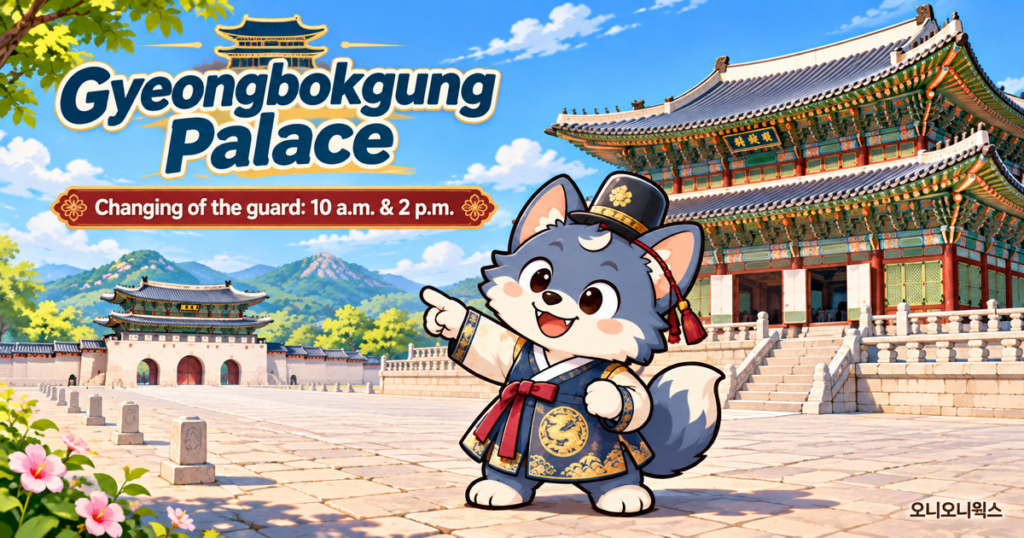
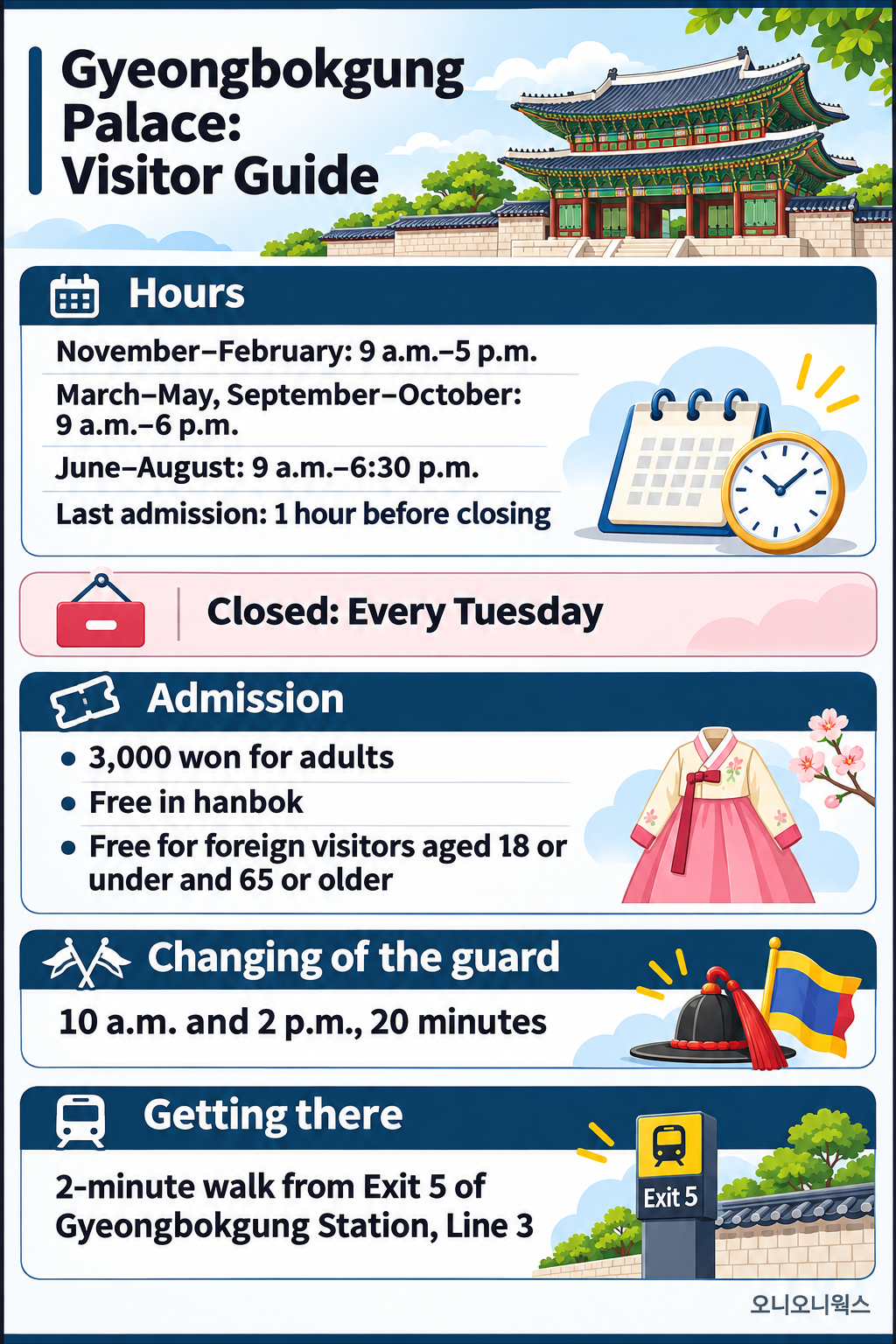
Gyeongbokgung Palace is closed every Tuesday. From November through February, it’s open from 9 a.m. to 5 p.m. Adult admission is 3,000 won. It’s free if you wear hanbok (한복, traditional Korean clothing). The changing of the guard takes place at 10 a.m. and 2 p.m.
I’ll walk you through the hours, admission fees, hanbok rules, how to see the ceremony, and how to get there.
At a glance
• Location: Jongno-gu, Seoul; a 2-minute walk from Exit 5 of Gyeongbokgung Station (경복궁역) on Subway Line 3
• Hours: 9 a.m.–5 p.m. in November–February; until 6 p.m. in March–May and September–October; until 6:30 p.m. in June–August
• Closed: Every Tuesday
• Admission: 3,000 won for adults; free in hanbok
• Changing of the guard: 10 a.m. and 2 p.m., 20 minutes
• Suggested routes: 40, 60, and 90 minutes
What is Gyeongbokgung Palace?
Gyeongbokgung Palace was first built in 1395 during the Joseon dynasty. It was Joseon’s main palace. It was also called the “Northern Palace” (북궐).
It burned down during the Japanese invasions of Korea in 1592 and was rebuilt in 1867. In 1915, during Japanese colonial rule, most of its buildings were demolished to make way for an exhibition. In 1926, the Japanese Government-General building was erected on the site.
The Government-General building was demolished between 1995 and 1997. From the 1990s onward, Heungnyemun Gate (흥례문), the king’s and queen’s sleeping quarters, Geoncheonggung Residence (건청궁), Taewonjeon Shrine (태원전), and Gwanghwamun Gate (광화문) were restored in stages. The palace you see today holds a history of destruction and rebuilding.
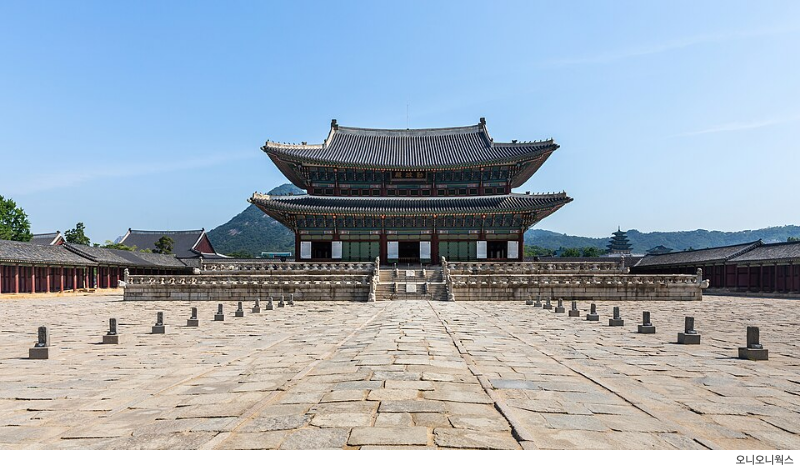
Geunjeongjeon Hall (근정전), where major state ceremonies were held, is a National Treasure. Gyeonghoeru Pavilion (경회루), a pavilion on a pond, is also a National Treasure. Geoncheonggung Residence, where Empress Myeongseong was killed in 1895, is inside the palace too.
Suggested routes through Gyeongbokgung Palace and foreign-language tours
You can explore Gyeongbokgung Palace in as little as 40 minutes, or take 90 minutes for a more relaxed visit. The Royal Palaces and Tombs Center suggests three routes based on the time you have.
| Route | Stops in order |
|---|---|
| 40 minutes | Heungnyemun Gate → Yeongjegyo Bridge (영제교) → Geunjeongjeon Hall → Sajeongjeon Hall (사정전) → Sujeongjeon Hall (수정전) → Gyeonghoeru Pavilion |
| 60 minutes | Heungnyemun Gate → Yeongjegyo Bridge → Geunjeongjeon Hall → Sujeongjeon Hall → Gyotaejeon Hall (교태전) → Gangnyeongjeon Hall (강녕전) → Sajeongjeon Hall → Gyeonghoeru Pavilion → Jagyeongjeon Hall (자경전) |
| 90 minutes | Heungnyemun Gate → Yeongjegyo Bridge → Geunjeongjeon Hall → Sujeongjeon Hall → Gyeonghoeru Pavilion → Sajeongjeon Hall → Gangnyeongjeon Hall → Gyotaejeon Hall → Jagyeongjeon Hall → Hyangwonjeong Pavilion (향원정) |
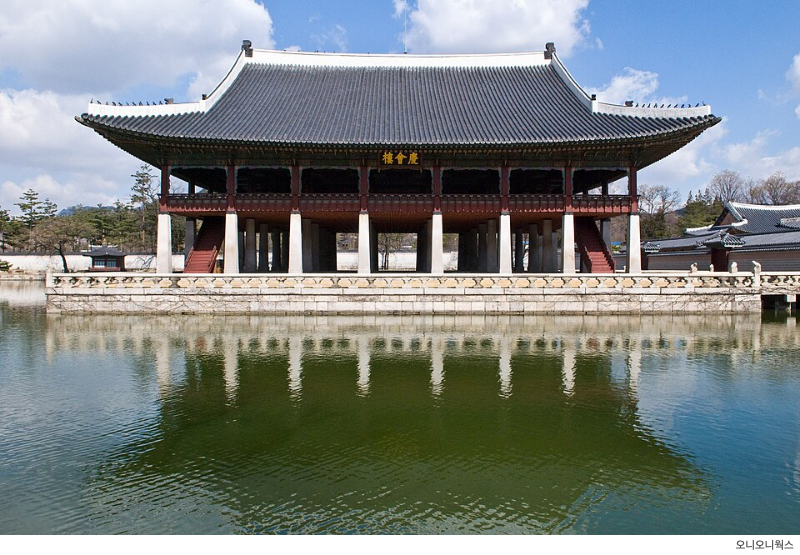
First, pass through Heungnyemun Gate and cross the stone Yeongjegyo Bridge to reach Geunjeongjeon Hall. Then see Sajeongjeon Hall, where the king worked, and Gyeonghoeru Pavilion on the pond.
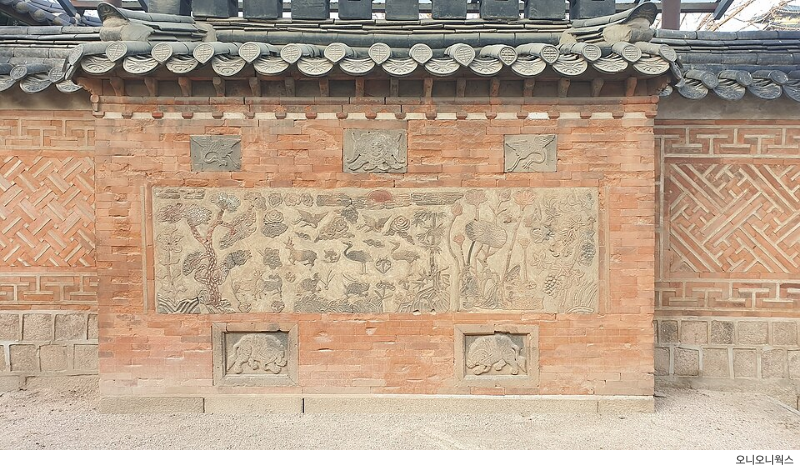
The 60-minute route also takes you to Gyotaejeon Hall, where the queen lived, and Gangnyeongjeon Hall, where the king slept. A chimney on the wall of Jagyeongjeon Hall is decorated with ten symbols of longevity. The chimney is a designated Treasure.
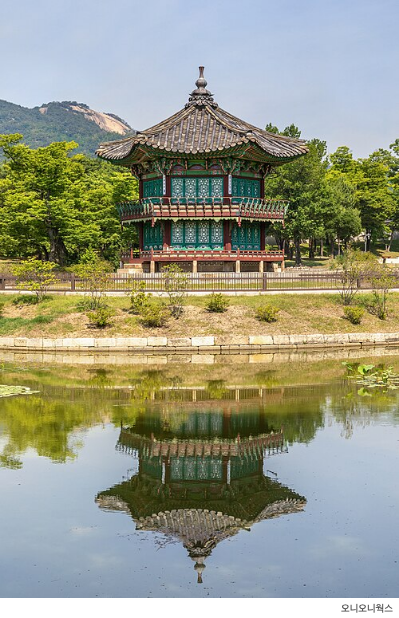
The 90-minute route takes you to Hyangwonjeong Pavilion, a small pavilion in the middle of a pond in the northern part of the palace. I’d recommend the 90-minute route for a first visit. The National Folk Museum of Korea (국립민속박물관) is next to Hyangwonjeong Pavilion. It’s easy to make that your next stop.
When are the foreign-language tours?
Foreign-language tours of Gyeongbokgung Palace leave at set times. Individual visitors in groups of fewer than 10 can join without a reservation.
| Language | Days | Departure times |
|---|---|---|
| English | Monday, Wednesday, Thursday, Friday, Saturday, Sunday | 11 a.m., 1:30 p.m., 3:30 p.m. |
| Japanese | Monday, Wednesday, Thursday, Friday, Saturday, Sunday | 10 a.m., 2:30 p.m. |
| Chinese | Monday, Wednesday, Thursday, Friday, Saturday, Sunday | 10:30 a.m., 3 p.m. |
| Spanish | Friday, Saturday | 10:30 a.m., 3 p.m. |
| French | Wednesday, Thursday | 11 a.m., 3 p.m. |
Tours leave from in front of the Gyeongbokgung Palace Information Office, inside Heungnyemun Gate. They take 1 to 1½ hours. Tours run even when it rains.
Oni’s tip
You can’t join a tour after it has departed. Arrive in front of the information office 10 minutes before the start. Don’t record video or audio without the guide’s permission.
Gyeongbokgung Palace changing of the guard: times and where to watch
The changing of the guard ceremony (수문장 교대식) takes place twice a day, at 10 a.m. and 2 p.m. Each ceremony lasts about 20 minutes. The sumunjang were military officers who guarded palace gates during the Joseon dynasty. The ceremony shows the guards handing over their duties.
The ceremony takes place in the plaza through Gwanghwamun Gate and up to the area in front of Heungnyemun Gate. The plaza is outside the ticket office. You can therefore watch the ceremony without an admission ticket. The ceremony doesn’t take place on Tuesdays, when Gyeongbokgung Palace is closed.
| Event | Time | Duration |
|---|---|---|
| Royal guard public training | 9:35 a.m., 1:35 p.m. | 15 minutes |
| Changing of the guard | 10 a.m., 2 p.m. | 20 minutes |
| Gwanghwamun Gate guard duty ceremony (광화문 파수의식) | 11 a.m., 1 p.m. | 10 minutes |
| Royal guard patrol ceremony (수문장 순라의식) | 3 p.m. on Saturdays, Sundays, and public holidays in March–May and September–November | 1 hour |
The guard duty ceremony shows guards standing watch at Gwanghwamun Gate. The patrol ceremony shows soldiers walking around the palace. On Saturdays, they walk inside Gyeongbokgung Palace. On Sundays, they walk from in front of Gwanghwamun Gate to Insadong Culture Street (인사동 문화의 거리).
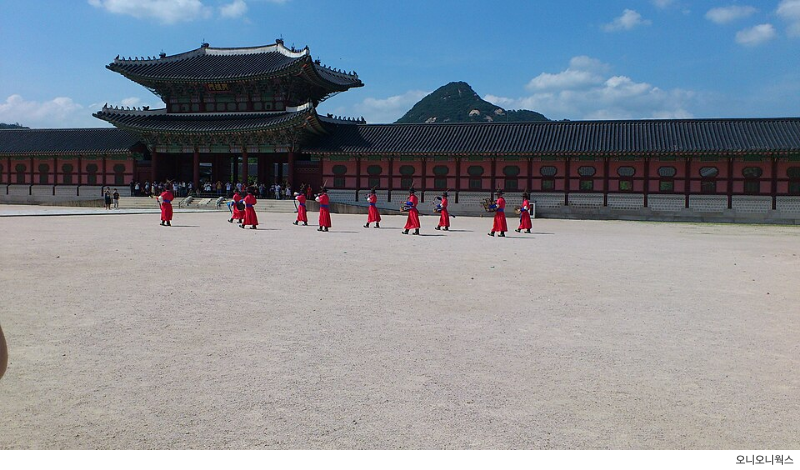
You can take photos with the guards. Don’t touch their flags or weapons. Don’t speak to the guards, either. During the event, don’t walk between them.
Events may be canceled or changed in extreme heat or bad weather. A heat wave warning was issued in the summer of 2026, and the events were suspended for a while. On days with bad weather, call the Korea Heritage Agency (02-3011-7750), which runs the event, to ask whether it’s taking place that day.
Oni’s tip
If you enter right after watching the 10 a.m. ceremony, the line at the ticket office is long. You could enter at 9 a.m. and explore the inside first. Then come out to the area in front of Heungnyemun Gate for the ceremony at 10 a.m.
How to get to Gyeongbokgung Palace: a 2-minute walk from Gyeongbokgung Station Exit 5
The palace is a 2-minute walk from Exit 5 of Gyeongbokgung Station on Subway Line 3. Subway station exits in Korea are numbered. Look for “5” on the yellow signs inside the station and follow them.
- Anguk Station (안국역), Line 3, Exit 1: a 6-minute walk
- Gwanghwamun Station (광화문역), Line 5, Exit 2: a 6-minute walk
- Bus: Routes 109, 171, 272, 601, 606, 710, 1020, and 7025 stop at “Gyeongbokgung” (경복궁)
- Map apps (Naver Map, KakaoMap, or Google Maps): Search for “경복궁”
From Gwanghwamun Station, you can walk toward the palace with Gwanghwamun Gate directly in front of you. It’s another good route for a first visit.
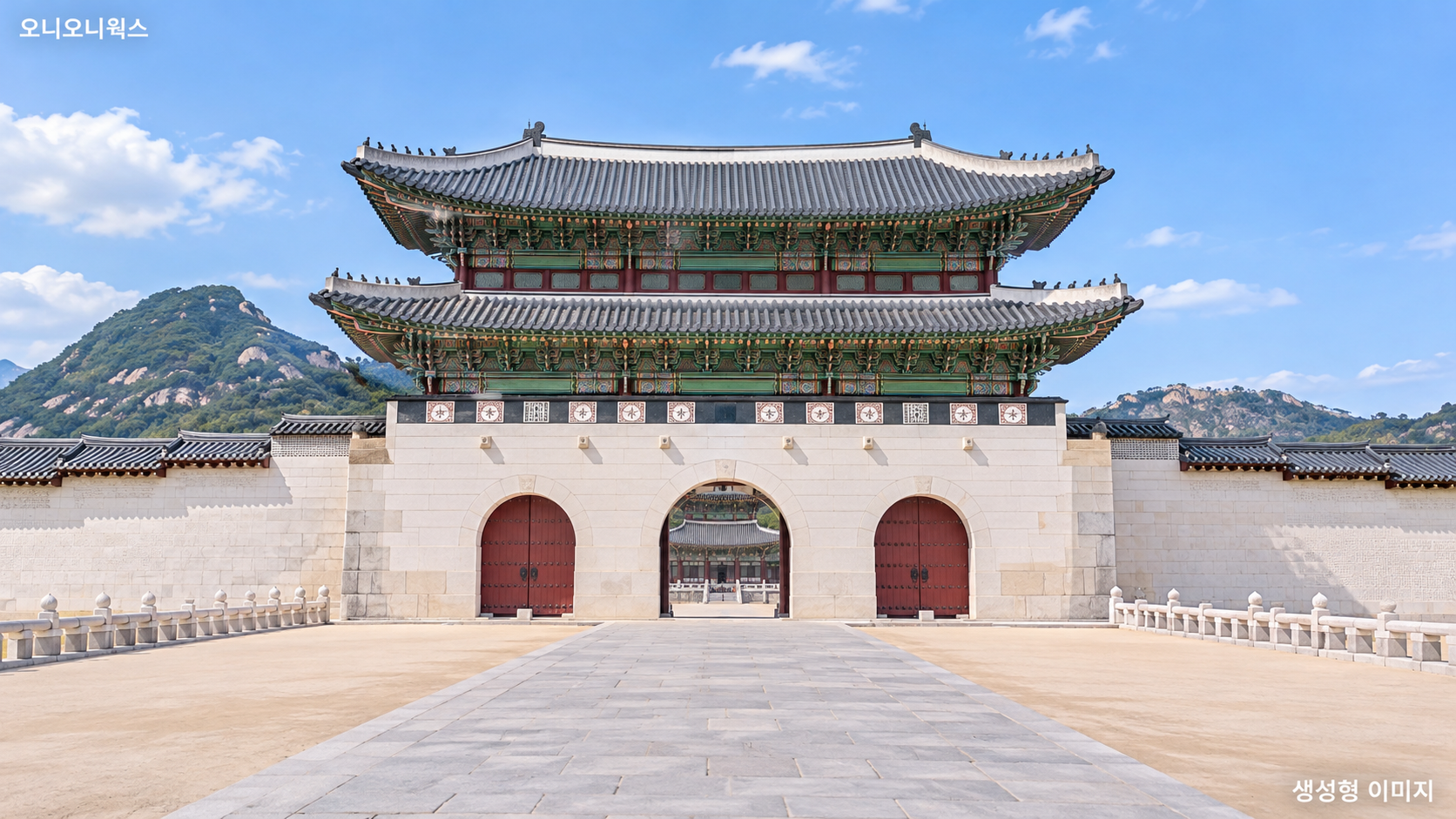
If you’re driving, you can use the Gyeongbokgung Palace parking lot. For a passenger car, the first hour costs 3,000 won. Each additional 10 minutes costs 800 won. The parking lot is open from 6 a.m. to 11 p.m.
 WelcomeLet's explore Korea together
Gyeongbokgung Palace hours, closures, and admission
Gyeongbokgung Palace’s closing time changes with the season. Last admission is 1 hour before closing. These details are current as of November 2026.
| Period | Hours | Last admission |
|---|---|---|
| November–February | 9 a.m.–5 p.m. | 4 p.m. |
| March–May, September–October | 9 a.m.–6 p.m. | 5 p.m. |
| June–August | 9 a.m.–6:30 p.m. | 5:30 p.m. |
Starting 30 minutes before closing, announcements guide visitors toward the exits.
Gyeongbokgung Palace is closed every Tuesday. If Tuesday is a public holiday, it opens and closes on the first weekday afterward. Changdeokgung Palace (창덕궁), Deoksugung Palace (덕수궁), and Changgyeonggung Palace (창경궁) are closed on Mondays. So you can switch your plans to one of these three palaces on a Tuesday.
| Admission | Who qualifies | Price |
|---|---|---|
| Adult | Foreign visitors aged 19–64 | 3,000 won |
| Group (10 or more) | Foreign visitors aged 19–64 | 2,400 won per person |
| Free | Foreign visitors aged 18 or under or 65 or older | 0 won |
| Free | Visitors wearing hanbok, regardless of nationality | 0 won |
Visitors entering free based on age must show ID. In Korea, there’s a day when cultural facilities open for free on Wednesdays. Gyeongbokgung Palace isn’t included in this free-admission day.
If you plan to visit several palaces, consider the Integrated Palace Ticket (궁궐 통합관람권) for 6,000 won. It gives you one entry each to Gyeongbokgung Palace, Changdeokgung Palace, Deoksugung Palace, Changgyeonggung Palace, and Jongmyo Shrine (종묘). It’s valid for 6 months from the date of purchase. Changdeokgung’s Secret Garden isn’t included. Tickets are sold at the ticket offices of the four palaces and Jongmyo Shrine.
Free admission in hanbok at Gyeongbokgung Palace: what qualifies?
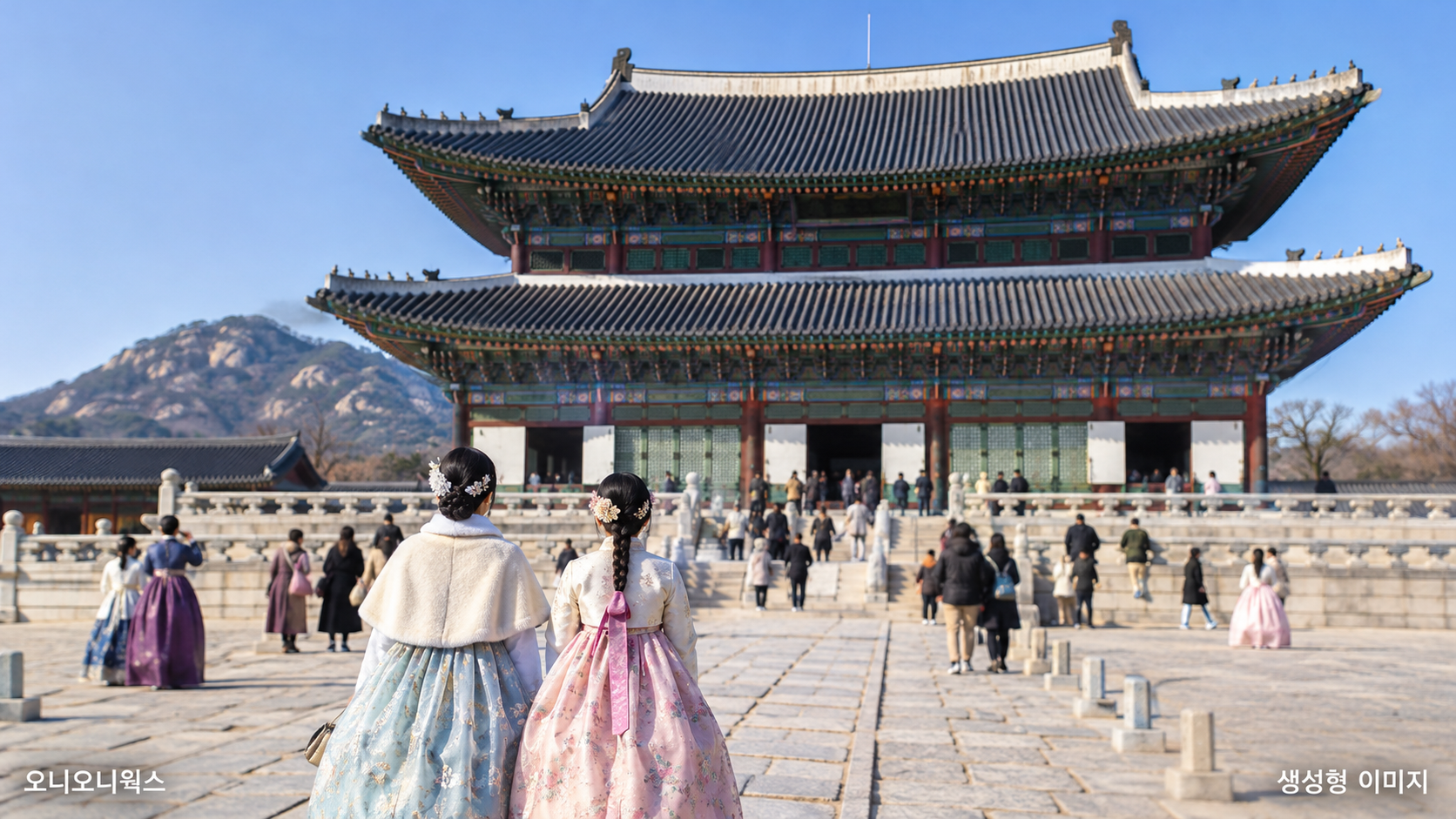
Foreign visitors can enter for free too if they’re properly dressed in hanbok. Both traditional hanbok and modern everyday hanbok qualify. The rule is to wear both a top (jeogori, 저고리) and a bottom (a skirt or pants).
These outfits qualify:
- Jeogori: It needs an overlapping collar at the front. Ties aren’t required.
- Skirt: It can have a fastening or not. When wearing a waist skirt with a jeogori, the jeogori must reach the waist.
- Pants: Hanbok-style pants qualify even if they have a zipper.
- Hanbok made of ramie is accepted under the same rules.
These outfits don’t qualify:
- A jeogori with jeans
- A T-shirt with a hanbok skirt or pants
- A one-piece hanbok dress without a jeogori
- A durumagi (두루마기, a long outer coat worn over hanbok) on its own
- An everyday hanbok top pulled over the head like a T-shirt
Visitors are encouraged to dress appropriately for the palace. Avoid overly revealing clothing.
Oni’s tip
Seoul is cold from November through February. Wear thin thermal underwear under your hanbok to stay warmer on a long walk.
Visitor tips and places to visit near Gyeongbokgung Palace
Visitors recommend arriving early for the changing of the guard. If you arrive right at 10 a.m., people are standing several rows deep around Gwanghwamun Gate. They suggest arriving at least 5–10 minutes early to choose a spot.
After the ceremony, the line for photos with the gatekeeper in front of Gwanghwamun Gate quickly gets long. It’s a good idea to join the line as soon as it ends. Some visitors say they took photos with other guards without waiting in line.
On sunny days, some visitors have watched the ceremony from the shade to the left of Gwanghwamun Gate. Several reviews also mention that there are many international visitors.
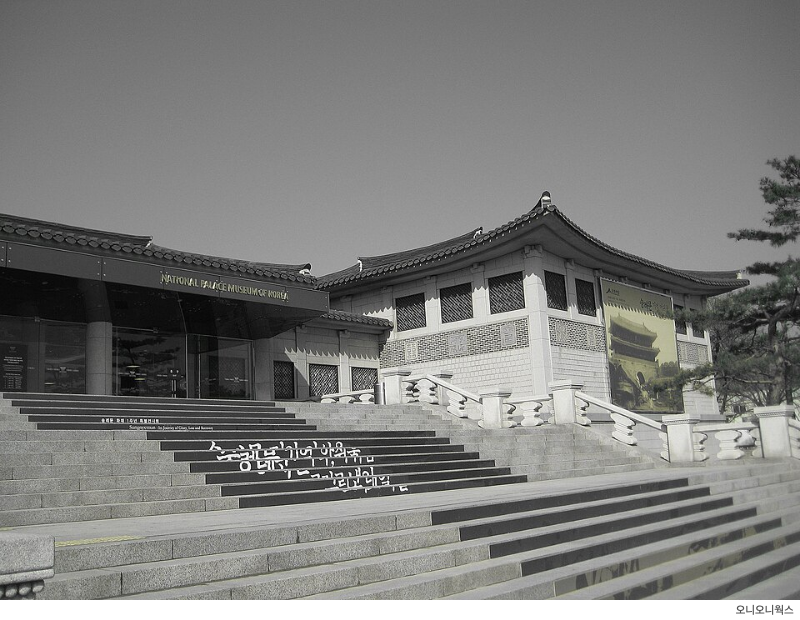
National Palace Museum of Korea, just outside Heungnyemun Gate
The National Palace Museum of Korea (국립고궁박물관) is west of Heungnyemun Gate, just outside it. Admission is free. It displays objects used by the Joseon royal family. It’s open from 9:30 a.m. to 5:30 p.m. on weekdays and Sundays. On Saturdays, it’s open until 9 p.m.
The museum is closed on the last Monday of every month. You can therefore visit on Tuesday, when Gyeongbokgung Palace is closed, except on January 1, Seollal, and Chuseok. English exhibition tours take place between 1 p.m. and 3 p.m. on weekdays. Japanese and Chinese exhibition tours are also offered during those hours.
National Folk Museum of Korea, east of Hyangwonjeong Pavilion
The National Folk Museum of Korea is inside Gyeongbokgung Palace, east of Hyangwonjeong Pavilion. Admission is free here too. From November through February, it’s open from 9 a.m. to 5 p.m. Permanent Exhibition Hall 1 is scheduled to remain closed until December 21, 2026.
Read next — How to Get to Haedong Yonggungsa Temple: Hours and Quieter Times to Visit Busan’s Seaside Temple
― ― ―
I recommend Gyeongbokgung Palace if you’re just starting to learn about Korean history. Enter at 9 a.m. and explore the inside first. Then watch the 10 a.m. changing of the guard for a full start to your day.
Opening hours and event schedules can change. Check the Royal Palaces and Tombs Center website (royal.khs.go.kr) before you go.
If you plan to rent hanbok, book your rental in advance for the day you visit Gyeongbokgung Palace. You’ll need to change early in the morning to make it for the 9 a.m. opening. Enjoy your trip to Seoul!
 HelloTry something special in Korea
This article brings together visitor information and reviews published through November 18, 2026. If you book through the reservation link above, this blog may earn a commission.
Sources: Korea Tourism Organization, “Gyeongbokgung Palace” · Royal Palaces and Tombs Center, “Opening Hours,” “Admission Fees,” “Hanbok Free Admission Guidelines,” “Visitor Routes,” “Guided Tours,” and “Directions” · Korea Heritage Agency, “Changing of the Royal Guard Ceremony Program” and “Visitor Information” · National Palace Museum of Korea, “Visitor Information” · National Folk Museum of Korea, “Visitor Information and Reservations” · Seoul Media Hub article on the changing of the guard · Insight article on the heat-related suspension
Photo credits: GPT 생성형 이미지 · Wikimedia Commons [https://commons.wikimedia.org/wiki/File:Front_view_of_the_Imperial_Throne_Hall_Geunjeongjeon_at_Gyeongbokgung_Palace_with_blue_sky_in_Seoul.jpg] · Wikimedia Commons [https://commons.wikimedia.org/wiki/File:Gyeonghoeru.jpg] · Wikimedia Commons [https://commons.wikimedia.org/wiki/File:%EA%B2%BD%EB%B3%B5%EA%B6%81_%EC%9E%90%EA%B2%BD%EC%A0%84_%EC%8B%AD%EC%9E%A5%EC%83%9D%EA%B5%B4%EB%9A%9D(%EA%B6%81%EB%8A%A5%EC%9C%A0%EC%A0%81%EB%B3%B8%EB%B6%80)-min.jpg] · Wikimedia Commons [https://commons.wikimedia.org/wiki/File:Water_reflection_of_Hyangwonjeong_Pavilion_at_Gyeongbokgung_Palace_in_Seoul.jpg] · Wikimedia Commons [https://commons.wikimedia.org/wiki/File:Changing_of_the_Guard_at_the_Gyeongbokgung.jpg] · Wikimedia Commons [https://commons.wikimedia.org/wiki/File:National_Palace_Museum_of_Korea.jpg]