In this post
- The one-day route through old downtown Jeju City at a glance
- First stop: explore Jeju Mokgwana for an hour
- Second stop: 30 minutes at Gwandeokjeong Pavilion next door
- Third stop: cross the suspension bridge at Yongyeon Pond
- Fourth stop: see the sea around sunset at Yongduam Rock
- Tips for an easy trip through old downtown Jeju City
- How other visitors enjoy the route
 Glad you're hereLet's explore Korea together
Have you landed at Jeju International Airport (제주국제공항) and wondered how to spend a day in Jeju City (제주시)?
I’ll show you a walking route through four places: Jeju Mokgwana (제주목 관아), Gwandeokjeong Pavilion (관덕정), Yongyeon Pond (용연), and Yongduam Rock (용두암).
The four stops are close to one another and to the airport. That makes this a good route for your first or last day.
At a glance
· Stops: 4 — Jeju Mokgwana → Gwandeokjeong Pavilion → Yongyeon Pond → Yongduam Rock
· Walking distance: about 1 km in total; a little over 20 minutes on foot
· Total time: about 3 hours, including sightseeing
· Starting point: in front of Gwandeokjeong Pavilion (15 minutes by car from the airport)
· Good for: anyone who wants to see history and the sea near the airport
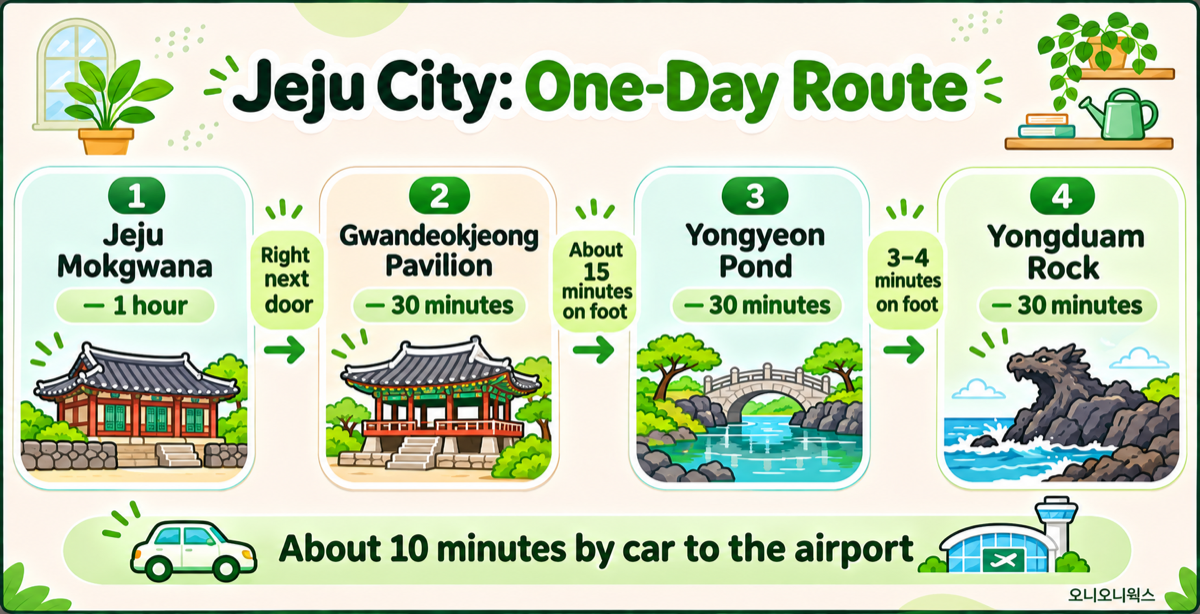
The one-day route through old downtown Jeju City at a glance
This route starts in old downtown Jeju City, the city’s former center, and ends by the sea.
Walk in this order: Jeju Mokgwana → Gwandeokjeong Pavilion → Yongyeon Pond → Yongduam Rock.
The total walking time is a little over 20 minutes.
Jeju Mokgwana and Gwandeokjeong Pavilion are right next to each other. The two buildings are about 46 m apart.
From Gwandeokjeong Pavilion to Yongyeon Pond, it’s about a 15-minute walk along neighborhood streets.
From Yongyeon Suspension Bridge (용연구름다리) to Yongduam Rock, it’s a 3–4-minute walk.
| Order | Stop | Time at the stop | To the next stop |
|---|---|---|---|
| 1 | Jeju Mokgwana | 1 hour | Right next door, 1 minute on foot |
| 2 | Gwandeokjeong Pavilion | 30 minutes | About 15 minutes on foot |
| 3 | Yongyeon Pond | 30 minutes | 3–4 minutes on foot |
| 4 | Yongduam Rock | 30 minutes | About 10 minutes by car to the airport |
These are the times I recommend spending at each stop.
Jeju Mokgwana has several buildings and exhibition rooms. I’d allow about an hour there.
If you’re mainly taking photos at Yongyeon Pond and Yongduam Rock, 30 minutes to an hour is enough for both.
First stop: explore Jeju Mokgwana for an hour
Jeju Mokgwana was the government office that administered Jeju during the Joseon Dynasty.
It opens at 9 a.m. and closes at 6 p.m. Last admission is at 5:30 p.m.
It’s open for daytime visits every day of the year.
Most of the buildings were demolished during the Japanese colonial period, leaving only Gwandeokjeong Pavilion.
The site was excavated four times from 1991 to 1998, and restoration was completed in December 2002.
Roof tiles donated by residents were used in the restoration.
It’s now a designated national historic site.
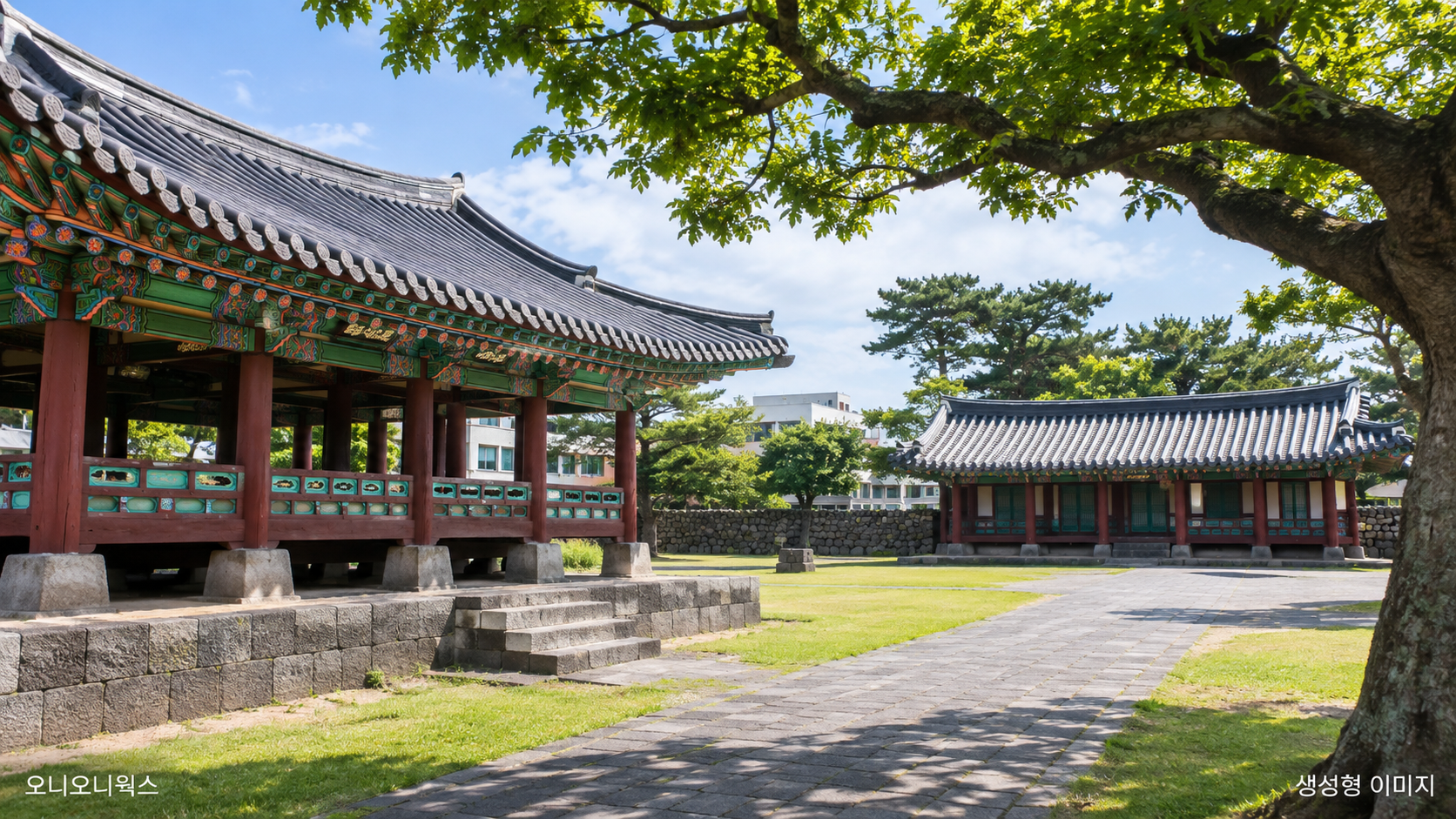
Inside, you can see buildings such as Manggyeongnu Pavilion (망경루) and Yeongjuhyeopdang Hall (영주협당).
The Jeju Mok History Museum (제주목 역사관) has three exhibition rooms.
There’s also a Tamna Sullyeokdo Experience Hall (탐라순력도 체험관). Tamna Sullyeokdo (탐라순력도) is an illustrated record of a Joseon-era Jeju governor’s tour of the island.
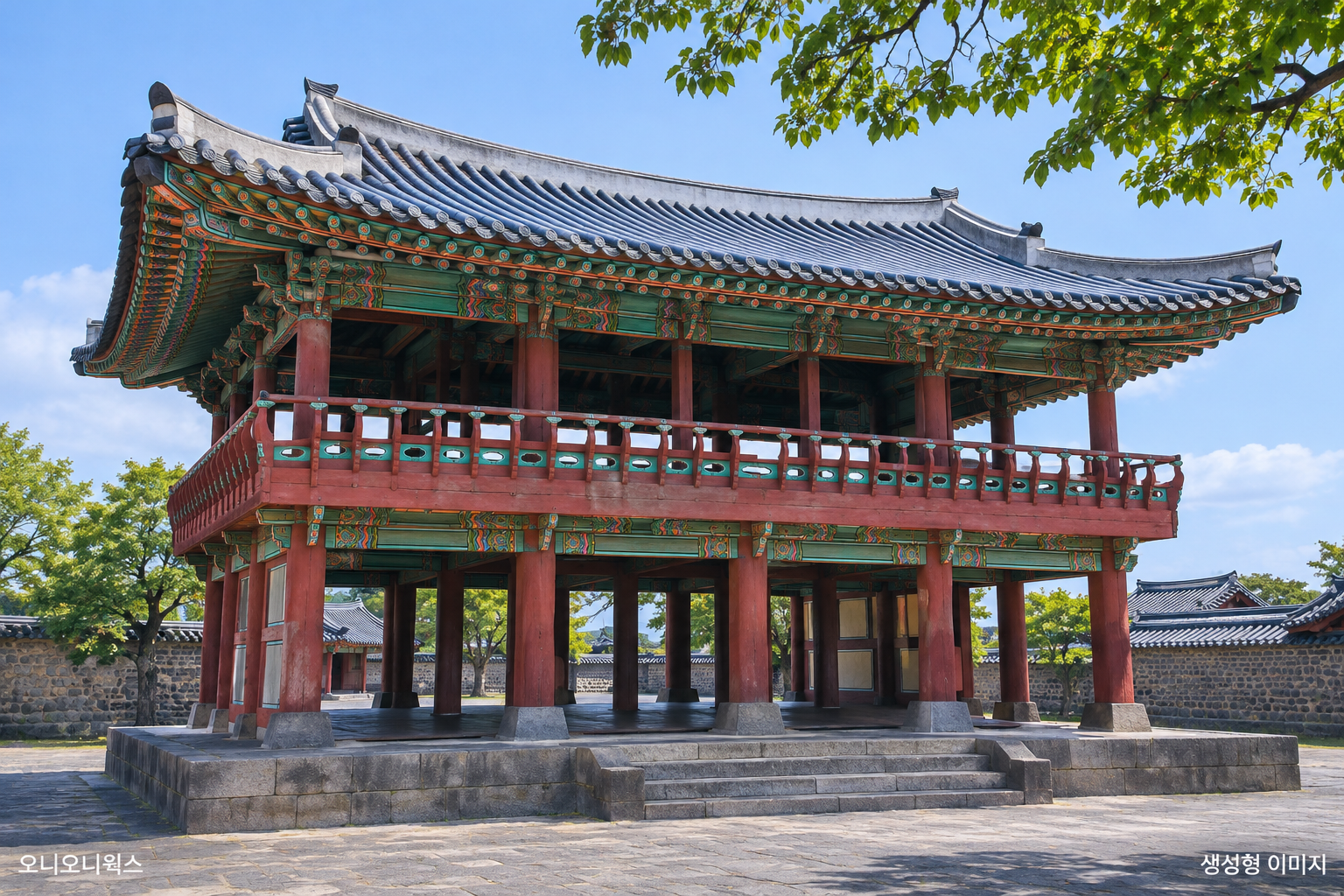
Admission is 1,500 won for adults ages 25–64.
It’s 800 won for visitors ages 13–24 and 400 won for children ages 7–12.
Children ages 6 and under enter free. Free admission for people ages 65 and over applies only to Korean citizens.
Buy your ticket at the ticket office by the entrance.
The site also opens at night from May through October.
Night opening hours are 6–9 p.m. Admission is free. It isn’t open on Monday or Tuesday nights.
From November through April, it closes at 6 p.m.
Oni’s tip — If you’d like to hear a guide, visit between 10 a.m. and 5 p.m. The guide information number is 064-710-6746. Call ahead to ask whether tours are available in other languages.
Second stop: 30 minutes at Gwandeokjeong Pavilion next door
Gwandeokjeong Pavilion stands directly in front of the main gate of Jeju Mokgwana. It’s a pavilion with pillars and a roof but no walls.
It was built for military training in 1448, the 30th year of King Sejong’s reign.
It’s now designated a national treasure of Korea.
You can visit Gwandeokjeong Pavilion from 9 a.m. to 6 p.m. It’s open every day.
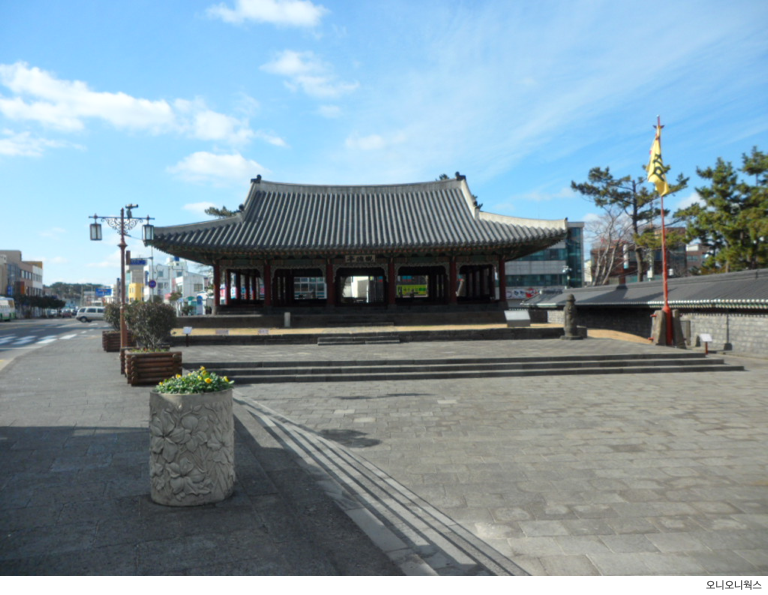
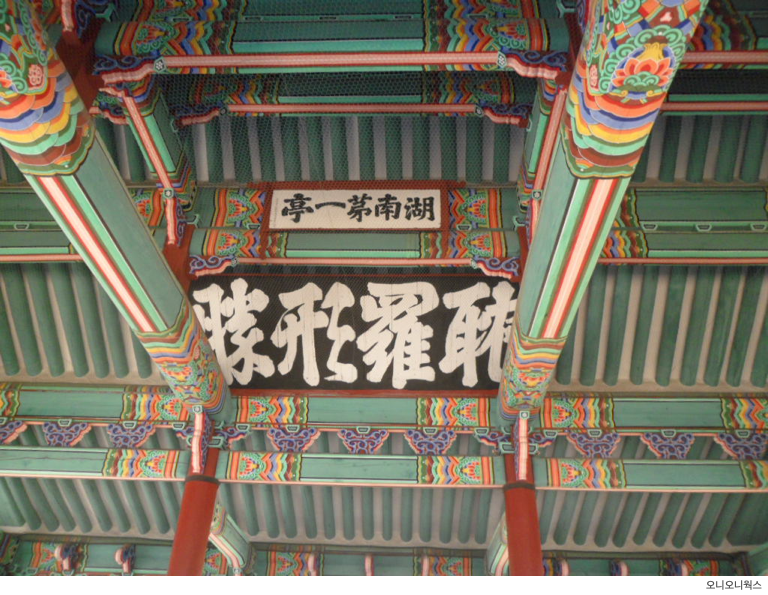
At the pavilion, look up beneath the roof.
Murals on the main beams depict scenes such as the Ten Symbols of Longevity, the Battle of Red Cliffs, and a grand hunt.
The signboard reading “Gwandeokjeong” on the front is said to have been written by Prince Anpyeong (안평대군) himself.
Inside, there are also signboards reading “Tamna Hyeongseung” (탐라형승) and “Honam Jeiljeong” (호남제일정).
The square in front of the pavilion has been the setting for many major events in Jeju’s history.
Jeju’s first five-day market, a traditional market held every five days, began in this square.
The Jeju April 3 Incident (제주 4·3사건), a painful event in Jeju’s modern history, also began here.
In the courtyard to the left of the main gate, you’ll see rows of stone monuments to former governors and magistrates.
Oni’s tip — Gwandeokjeong Pavilion is next to Jeju Mokgwana, so you can see it as you leave the government office. Call 064-710-6718 to ask whether you need a separate ticket to go up into the pavilion.
Third stop: cross the suspension bridge at Yongyeon Pond
Yongyeon Pond is a deep pool where fresh water meets seawater as a stream flows into the sea.
Its name means “pond where dragons played.”
A dragon story is associated with the pond, which is said never to dry up even during a drought.
It’s about a 15-minute walk from Gwandeokjeong Pavilion to Yongyeon Pond.
Search for “용연구름다리” in your map app and follow the walking directions.
The route from the pavilion through Mugeunseong-gil (무근성길) to the bridge follows Seongan Olle Course 2 (성안올레 2코스), a walking route through the old downtown.
Yongyeon Pond is free to visit. It’s open all day, all year round.
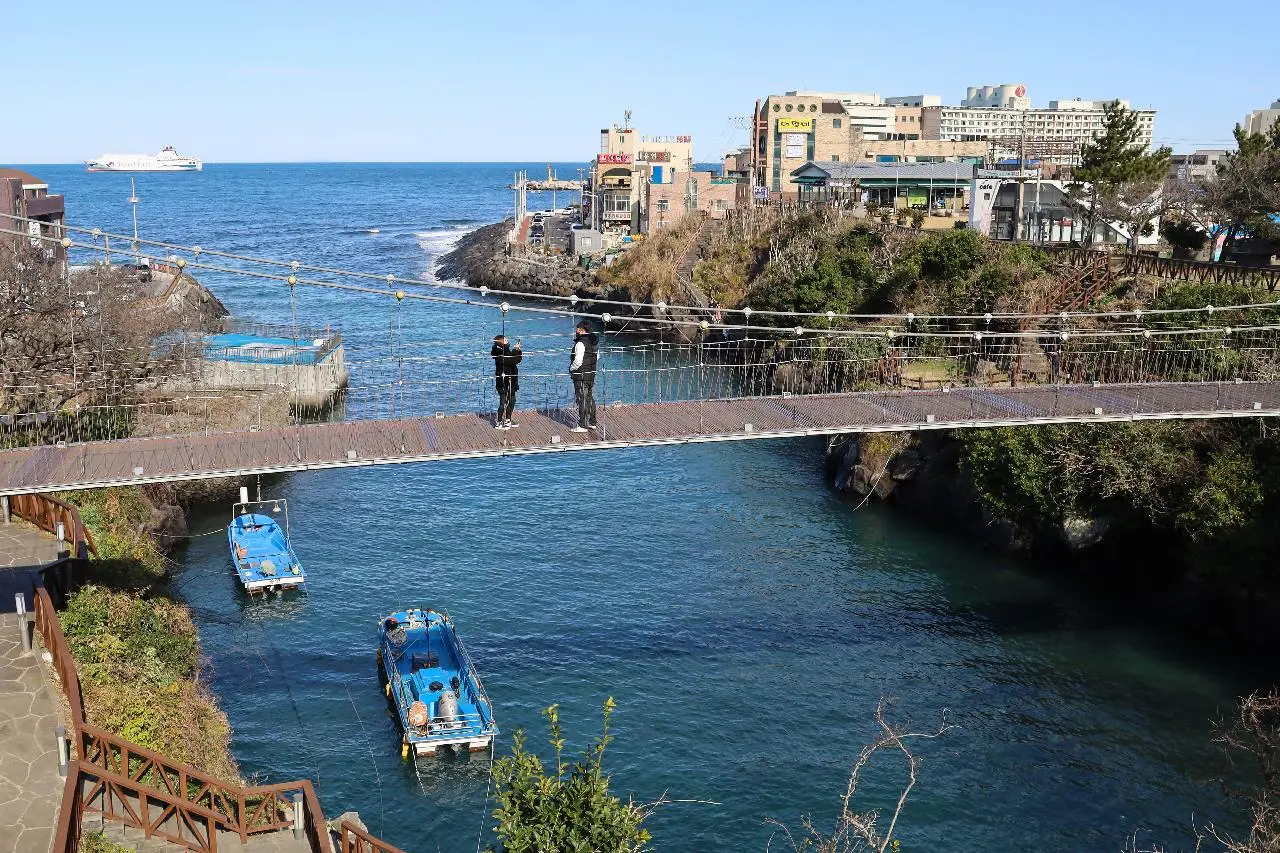
Yongyeon Suspension Bridge is a swaying bridge that connects the rocky cliffs on either side of the gorge.
Look down from the bridge and you’ll see deep green water.
At night, the bridge lights up in several colors.
During the late Joseon Dynasty, people floated boats here at night and composed poetry.
The scene, called “Yongyeon Yabeom” (용연야범), is included in the “Twelve Scenic Views of Yeongju” (영주십이경), a collection of twelve beautiful Jeju landscapes.
Yongyeon Pond is also on Jeju Olle Trail Route 17 (제주 올레 17코스), part of a walking trail that circles Jeju Island.
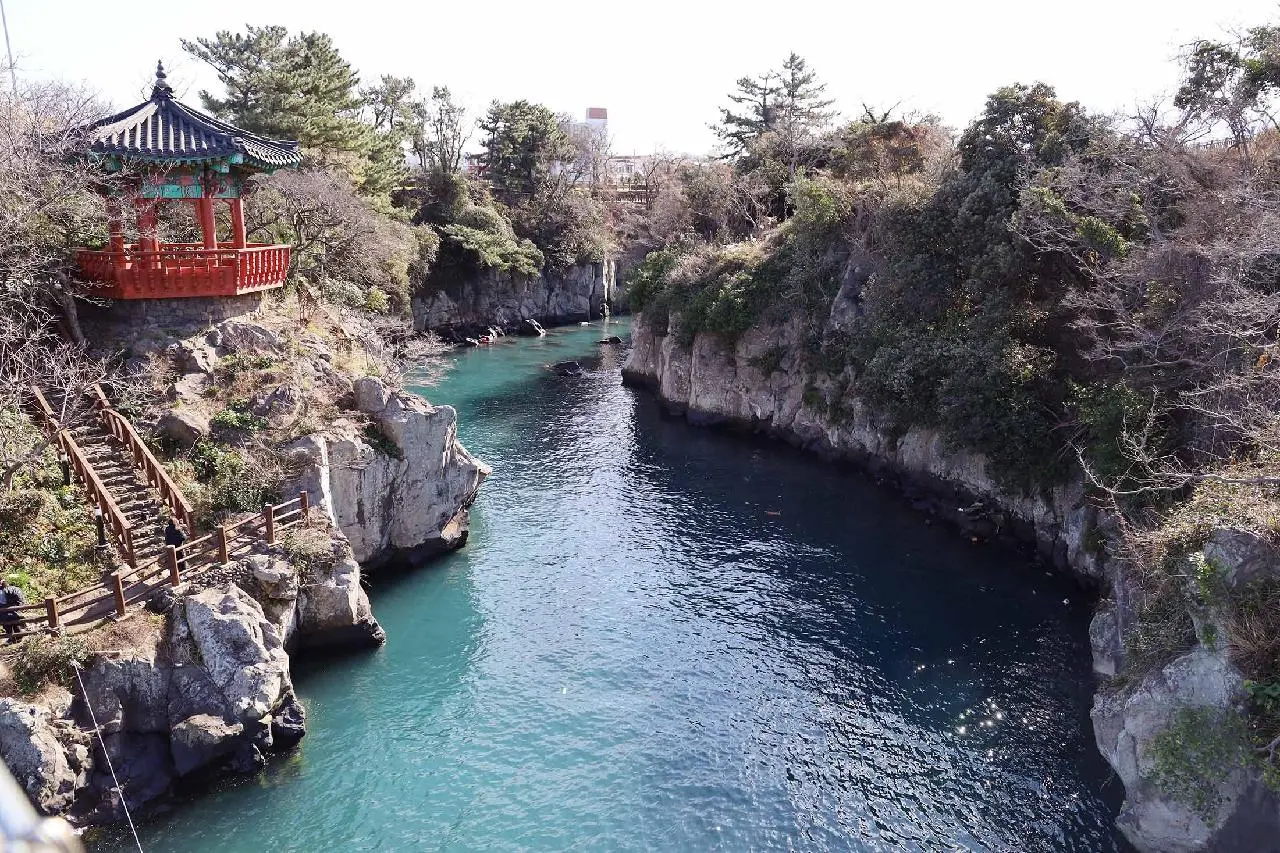
Oni’s tip — The Korea Tourism Organization’s free audio guide app, Odii (오디), has a guide to Yongyeon Pond. Listen before you cross the bridge to learn more about the gorge’s stories.
 WelcomeLet's explore Korea together
Fourth stop: see the sea around sunset at Yongduam Rock
Yongduam Rock is a coastal rock formation a 3–4-minute walk from Yongyeon Suspension Bridge.
Waves and wind shaped it. It looks like a dragon raising its head toward the sky.
It’s free to visit and can be seen at any time of year.
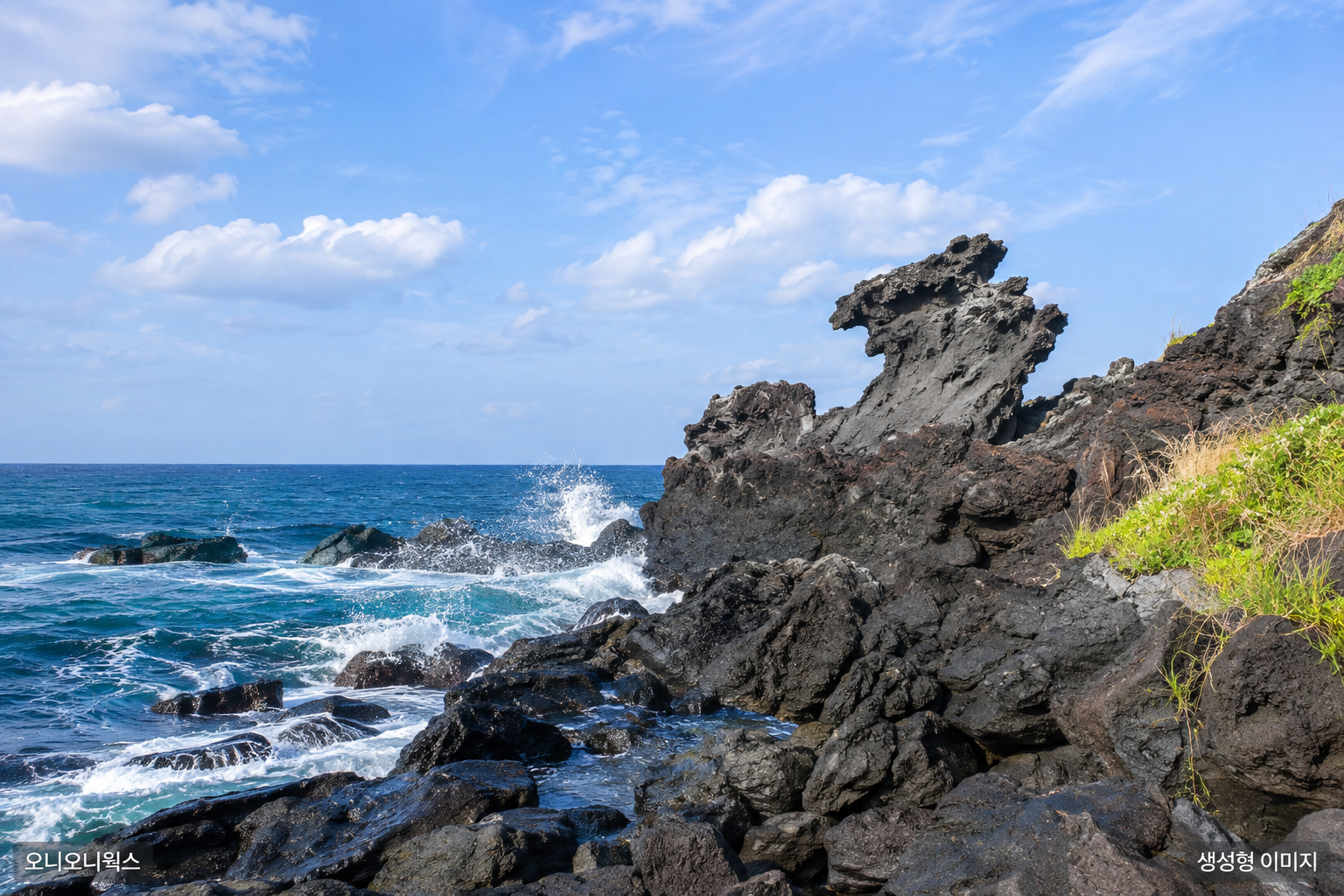
There are two legends about Yongduam Rock.
One tells of a dragon that turned to stone after stealing a jade bead from the spirit of Hallasan Mountain (한라산).
The other tells of a white horse that turned to stone while trying to become a dragon.
Yongduam Rock is on the north coast near the airport. The airport is about 10 minutes away by car.
The Yongdam–Dodu Coastal Road (용담-도두 해안도로) follows the shore from Yongduam Rock.
Oni’s tip — I’d finish this route in the late afternoon. If you reach Yongduam Rock around sunset, you can see the sunset and the sea together. Sunset time changes every day. Check that day’s sunset time in a weather app before you set out.
Read next — A Day in Busan: Gamcheon Culture Village and Dadaepo by Public Transportation, Ending at Sunset
Tips for an easy trip through old downtown Jeju City
Morning is a good time to start.
Jeju Mokgwana closes at 6 p.m., and last admission is at 5:30 p.m.
Visit the government office and Gwandeokjeong Pavilion in the morning, then walk toward the coast in the afternoon for a relaxed schedule.
There’s no night opening at the government office from November through April. During those months, make sure you visit it first during the day.
It’s 15 minutes by car from the airport to Gwandeokjeong Pavilion. It’s under 30 minutes by public transportation.
If you’re taking a bus, search for “관덕정” in KakaoMap or Naver Map. The app will show you the bus number and stops.
If you’re taking a taxi, show the driver the Korean name “관덕정.”
You can also take the Jeju City Tour Bus (제주시티투어 버스) back to the airport from Yongyeon Pond.
The bus stops at Samdo 119 Center (Yongyeon Suspension Bridge) (삼도119센터(용연구름다리)) at 49 minutes past the hour.
The next stop is Jeju International Airport, first floor, stop 3, where it arrives on the hour.
It operates from 8:30 a.m. to 7 p.m. and runs 9 times a day. In January and February, the last bus leaves the airport at 5 p.m.
Ask the Jeju City Tour customer center about fares and days off in advance.
If you’ve rented a car, use a public parking lot near Gwandeokjeong Pavilion.
The parking lot reserved for Jeju Mokgwana is small.
There’s a public parking lot about 100 m west of Gwandeokjeong Pavilion. It’s free on weekends, public holidays, and at night.
There’s also a parking lot at Yongduam Rock.
| Place | Hours | Days closed | Fee | Contact |
|---|---|---|---|---|
| Jeju Mokgwana | 9 a.m.–6 p.m. (last admission 5:30 p.m.) | None | Adults 1,500 won | 064-710-6717 |
| Gwandeokjeong Pavilion | 9 a.m.–6 p.m. | None | Ask at Jeju Mokgwana | 064-710-6718 |
| Yongyeon Pond and Yongyeon Suspension Bridge | Always open | None | Free | 064-740-6000 |
| Yongduam Rock | Always open | None | Free | 064-740-6000 |
The hours and fees in the table are as of November 2026.
Oni’s tip — Admission to Jeju Mokgwana is a small amount. To be prepared in case the ticket office doesn’t accept cards, bring 1,500 won in cash. You can also ask for directions at the Yongduam Tourist Information Center (용두암 관광안내소), 064-728-3917.
Read next — A Day in Nampo-dong, Busan: A Walking Route from the 40 Steps to BIFF Square
How other visitors enjoy the route
Visitors say sunset is their favorite time at Yongduam Rock.
Photos capturing the sunset, sea, and planes taking off from or landing at the airport in one frame are popular.
Visitors say Yongyeon Suspension Bridge doesn’t sway as much as they expected and isn’t very long. Even people who are afraid of heights can manage the crossing.
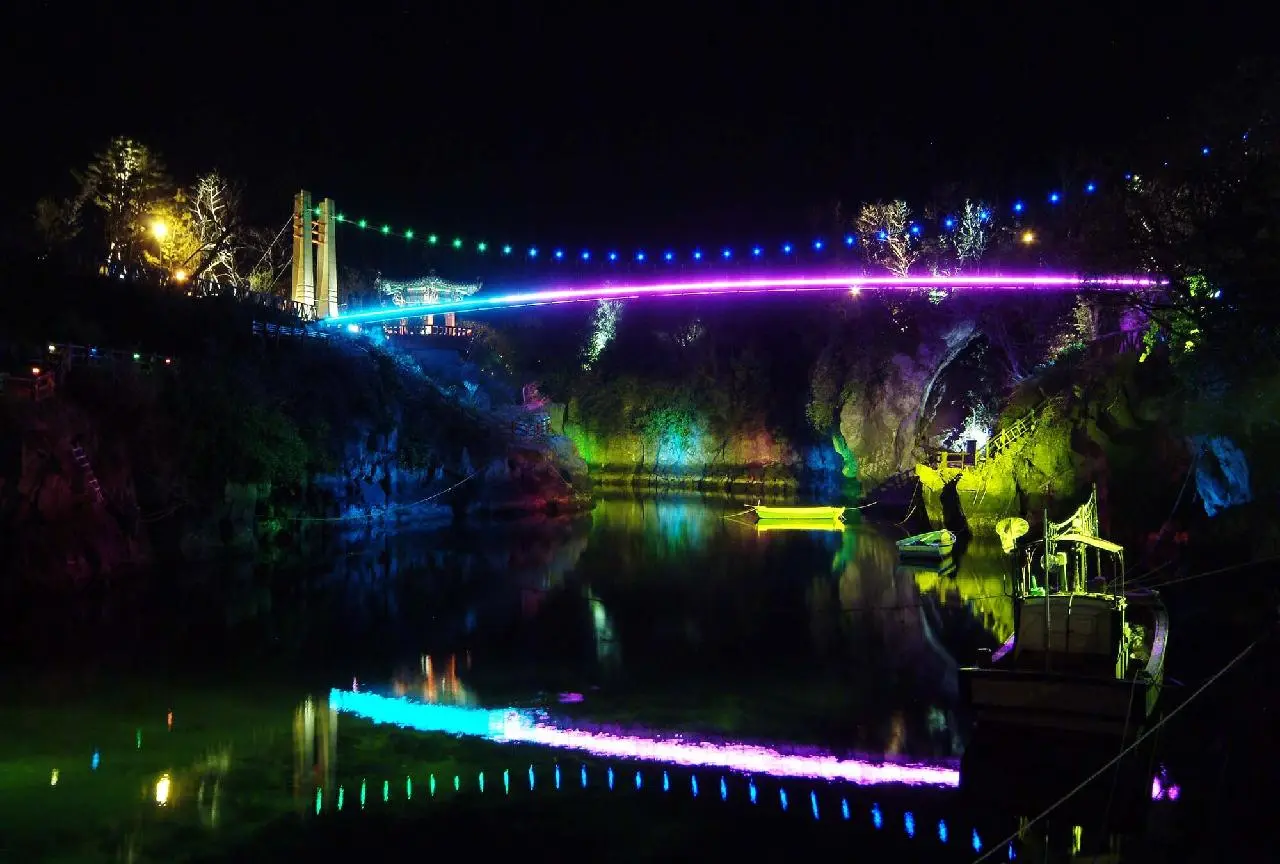
Visitors say the bridge lights come on after sunset.
After watching the sunset at Yongduam Rock, many walk 3–4 minutes back to the bridge to see the lights.
Some visitors have said they saw more international visitors than Korean visitors at Jeju Mokgwana.
Visitors who went in March have mentioned seeing plum blossoms in the government office courtyard.
If you’d like a longer walk, try Seongan Olle Course 2.
This route is about 6 km long. It starts at Sanjicheon Stream (산지천), passes Yongyeon Suspension Bridge, Gwandeokjeong Pavilion, and Ohyeondan Altar (오현단), and returns to Sanjicheon Stream. It takes about 2 hours on foot.
― ― ―
I recommend this old downtown Jeju City route if you’d like to spend half a day to a day near the airport.
It’s a good trip for the afternoon you arrive in Jeju or before your flight on the day you leave.
Opening hours and fees can change. Check the official Jeju Mokgwana website before you go.
This route makes frequent use of buses and map apps. Before coming to Korea, get data ready with an eSIM, a digital SIM built into your phone. You can buy one directly through the booking link below. Enjoy your trip to Jeju!
 HelloStay connected the whole trip
This article brings together tourist information and visitor reviews available on November 17, 2026. I may earn a commission if you book through a booking link in this article.
References: Korea Tourism Organization tourism information (TourAPI): Jeju Mokgwana, Gwandeokjeong Pavilion (Jeju), Yongyeon Pond, and Yongduam Rock · VisitKorea, “Yongyeon Suspension Bridge” (https://korean.visitkorea.or.kr/detail/ms_detail.do?cotid=dcf2233a-d5e0-45e5-8cc4-72ca91ec4acb) · VisitKorea, “From Gwandeokjeong Pavilion to Ohyeondan Altar: A Walk Through History and Nature in Old Downtown Jeju City” (https://korean.visitkorea.or.kr/detail/detail_view.do?cotid=714f2f76-5147-48c6-af57-cf5ba3d187e1) · VisitKorea, “Walking Through Old Downtown Jeju City: Seongan Olle” (https://korean.visitkorea.or.kr/detail/detail_view.do?cotid=7d614ea4-f5e3-4add-922e-45e9877b9c7c) · VisitKorea, “Relax at Your Own Pace in Jeju’s Nature” (https://korean.visitkorea.or.kr/detail/detail_view.do?cotid=7cf69c9d-089c-42a5-a3fe-8e065b1f6196) · Jeju Mokgwana website: visitor information, admission fees and hours, and directions (https://www.jeju.go.kr/mokkwana/index.htm) · Jeju City Tour circular route timetable (https://www.jejucitybus.com/coast/timetable) · Naver Blog reviews (https://blog.naver.com/6to8-/224437473583 · https://blog.naver.com/coco931/224168620863 · https://blog.naver.com/battlemagehun/224403593395 · https://blog.naver.com/smallonetamna/224217910563 · https://blog.naver.com/tjdalsdlz2/224475033112)
Photo credits: GPT 생성형 이미지 · Wikimedia Commons [https://upload.wikimedia.org/wikipedia/commons/f/fd/Gwandeokjeong_Pavilion.JPG] · Wikimedia Commons [https://upload.wikimedia.org/wikipedia/commons/e/e3/Two_Signboards_in_Gwandeokjeong.JPG] · 비짓제주 [https://api.cdn.visitjeju.net/photomng/imgpath/202311/22/73a298ad-cf19-4e47-86dd-0a836897cdd0.webp] · 비짓제주 [https://api.cdn.visitjeju.net/photomng/imgpath/202311/28/5b3bc462-0734-4dc2-b1c1-7b9543b59690.webp] · 비짓제주 [https://api.cdn.visitjeju.net/photomng/imgpath/202311/28/517a602c-0c88-4874-b6e8-6e0aa1b14326.webp]