In this post
 Glad you're hereLet's explore Korea together
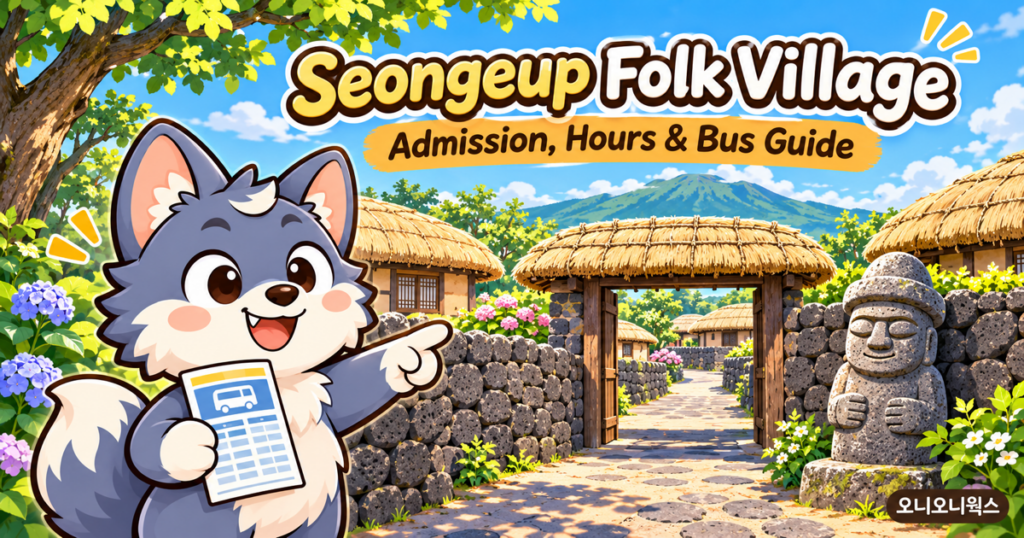
Want to walk through an old village in eastern Jeju (제주) and wondering how much it costs and whether you can get there by bus?
Seongeup Folk Village (성읍민속마을) has no admission fee, and you can enter at any time without set visiting hours.
I’ll show you how to get there by bus from Jeju Airport (제주국제공항), Jeju City (제주시), and Seogwipo (서귀포), plus a one-hour walking route.
At a glance
· Location: Pyoseon-myeon (표선면), Seogwipo, Jeju, about 8 km north of Pyoseon (표선)
· Admission: Free
· Visiting hours: No set hours or closing days. Go before sunset
· Time needed: About 1 hour
· Buses: 121 and 122 from Jeju Airport; 221 and 222 from Jeju Bus Terminal (제주버스터미널)
· Good for: Anyone who wants to walk among Jeju’s old houses and stone walls in a Joseon-era village
What is Seongeup Folk Village?
Seongeup Folk Village was the main village of Jeongui-hyeon (정의현), which governed eastern Jeju during the Joseon era.
A hyeon (현) was a local administrative district during the Joseon era.
From 1416 to 1914, this village was the administrative center of Jeongui-hyeon for about 500 years.
This isn’t a village set up like a museum.
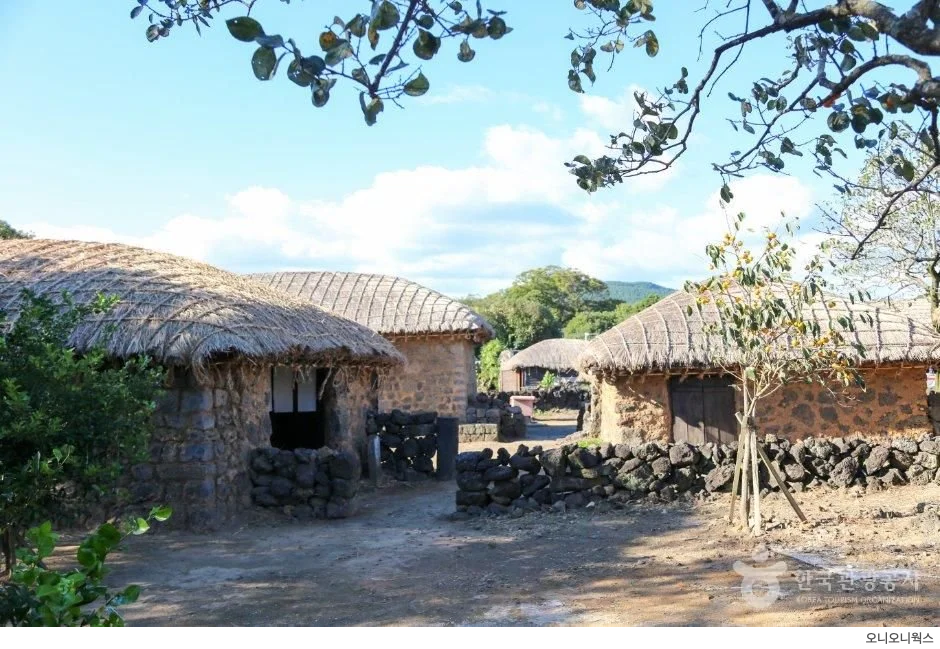
Residents still live in the thatched houses, which have roofs made of straw.
As you walk through this living village, you can see old government buildings, fortress walls, a hyanggyo (향교, a local school from the Joseon era), and dol hareubang (돌하르방, Jeju stone statues).
The entire village was designated a National Folklore Cultural Heritage site, Jeju Seongeup Village (제주 성읍마을), in 1984.
The village preserves more than houses and buildings.
Living traditions such as Jeju folk songs, folk games, local food, and the Jeju dialect continue here too.
You can also see a tongsi (통시), a traditional Jeju toilet that also served as a pigsty.
Oni’s tip
People live in this village. Don’t enter houses with closed doors. Please walk quietly through the lanes. Even historic houses designated as cultural heritage may be closed to visitors depending on the owners’ circumstances.
What to see at Seongeup Folk Village: A one-hour walking route
It takes about 1 hour to walk around the village.
You can follow the route suggested by the Korea Tourism Organization.
- Village entrance marker stone
- The walls and gates of Jeonguihyeonseong Fortress (정의현성)
- An olle (올레, a narrow lane leading to a house)
- Historic House of Go Pyeong-o (고평오 고택)
- Historic House of Go Chang-hwan (고창환 고택) and Jeonguihyanggyo Confucian School (정의향교) right next door
Jeonguihyeonseong Fortress gates and dol hareubang
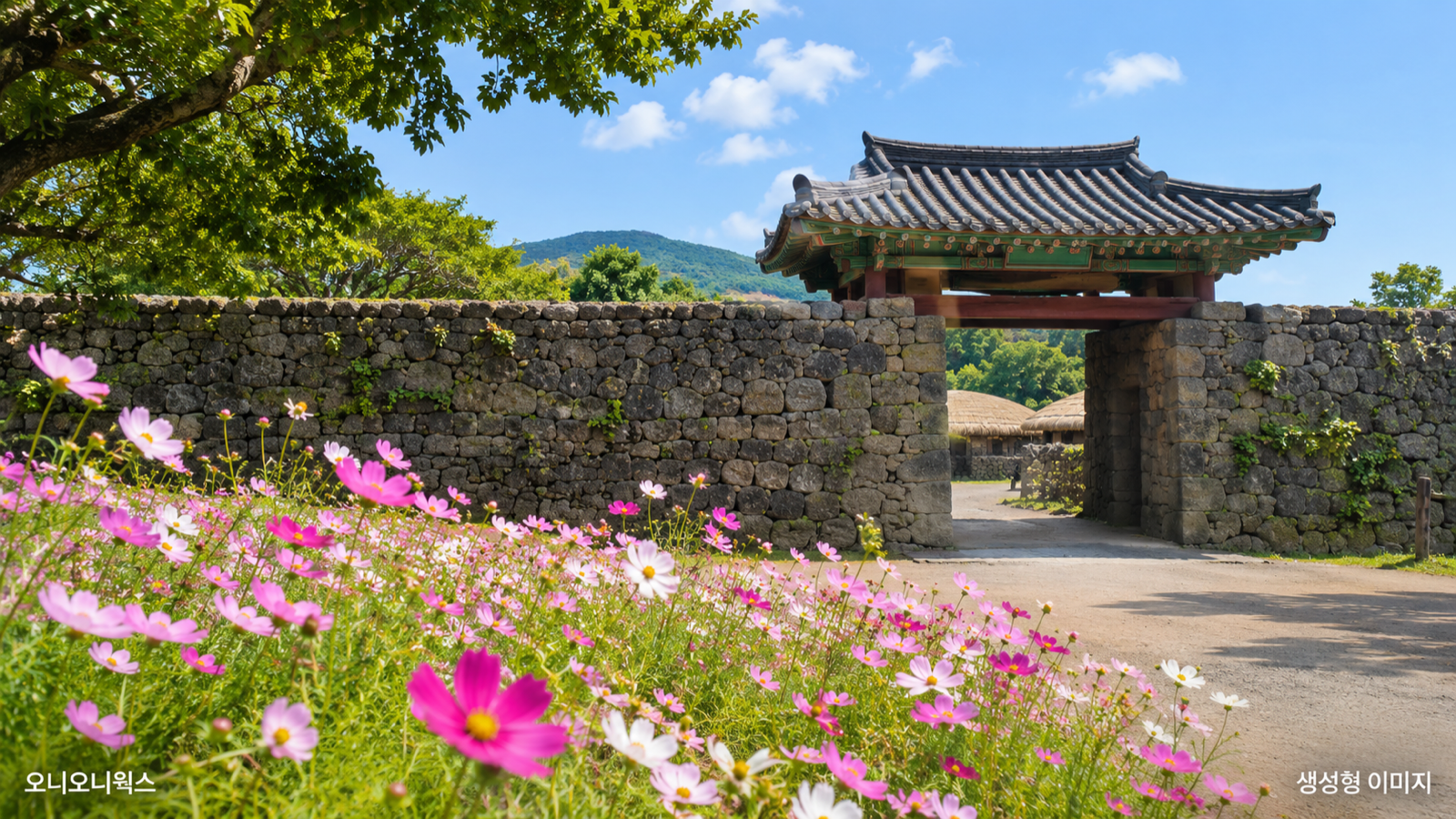
At the village entrance, you’ll first see basalt fortress walls and a gate.
A tiled-roof pavilion stands above the wall.
The fortress was relocated and rebuilt at its present site in Seongeup-ri (성읍리) in January 1423.
People from across Jeju were brought together to complete it in 5 days.
The fortress has been restored and repaired several times since then.
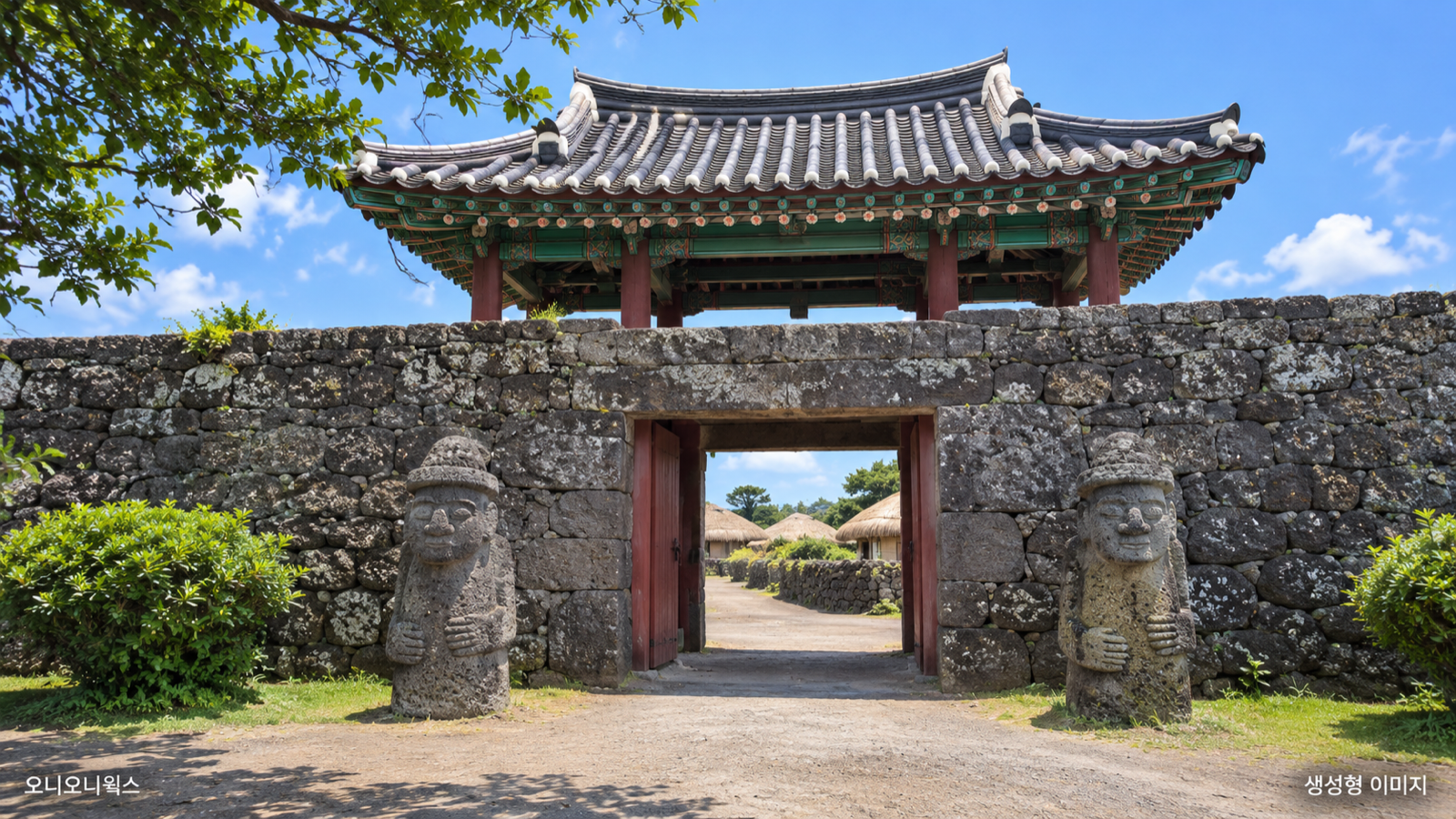
Dol hareubang stand in front of the gates.
These stone statues are carved from Jeju stone in the image of grandfathers.
There are 45 old dol hareubang across Jeju, and 12 of them are in Seongeup-ri.
They stand in front of the east, west, and south gates. Their average height is 141 cm.
They’re thought to have been made around 1754.
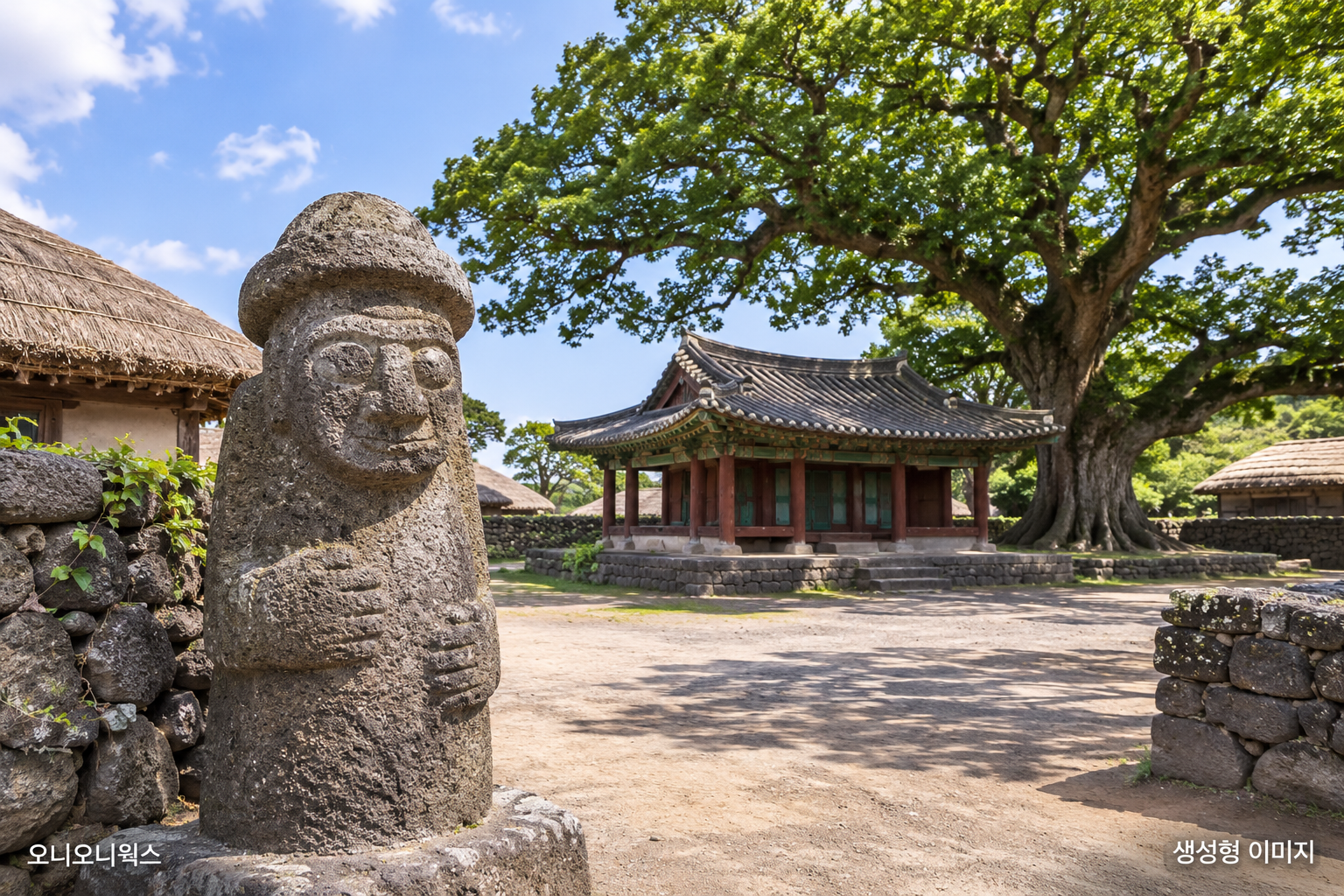
Ilgwanheon and the thousand-year-old zelkova tree
Ilgwanheon (일관헌) is an old government building where the magistrate of Jeongui-hyeon worked.
It’s also called Geunminheon (근민헌).
This was the center of Jeongui-hyeon until the district was abolished in 1914.
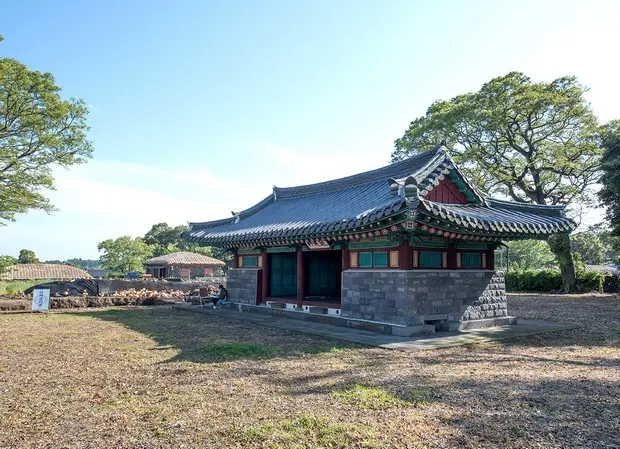
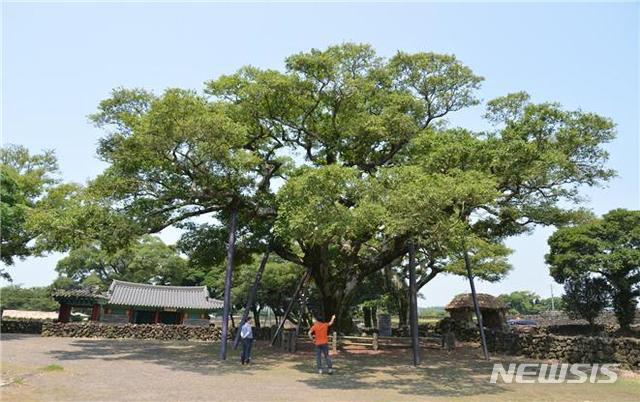
Large trees stand around Ilgwanheon.
One zelkova tree is 30 m tall and is thought to be about 1,000 years old.
Three hackberry trees are thought to be about 600 years old.
These trees were designated Natural Monuments in 1964.
The historic houses of Go Pyeong-o and Go Chang-hwan
The Historic House of Go Pyeong-o is a thatched house said to have been built in 1829.
Its visiting hours are 10 a.m.–5 p.m.
You can see the layout of a Jeju thatched home, with the main house, outer house, and side building arranged around a courtyard.
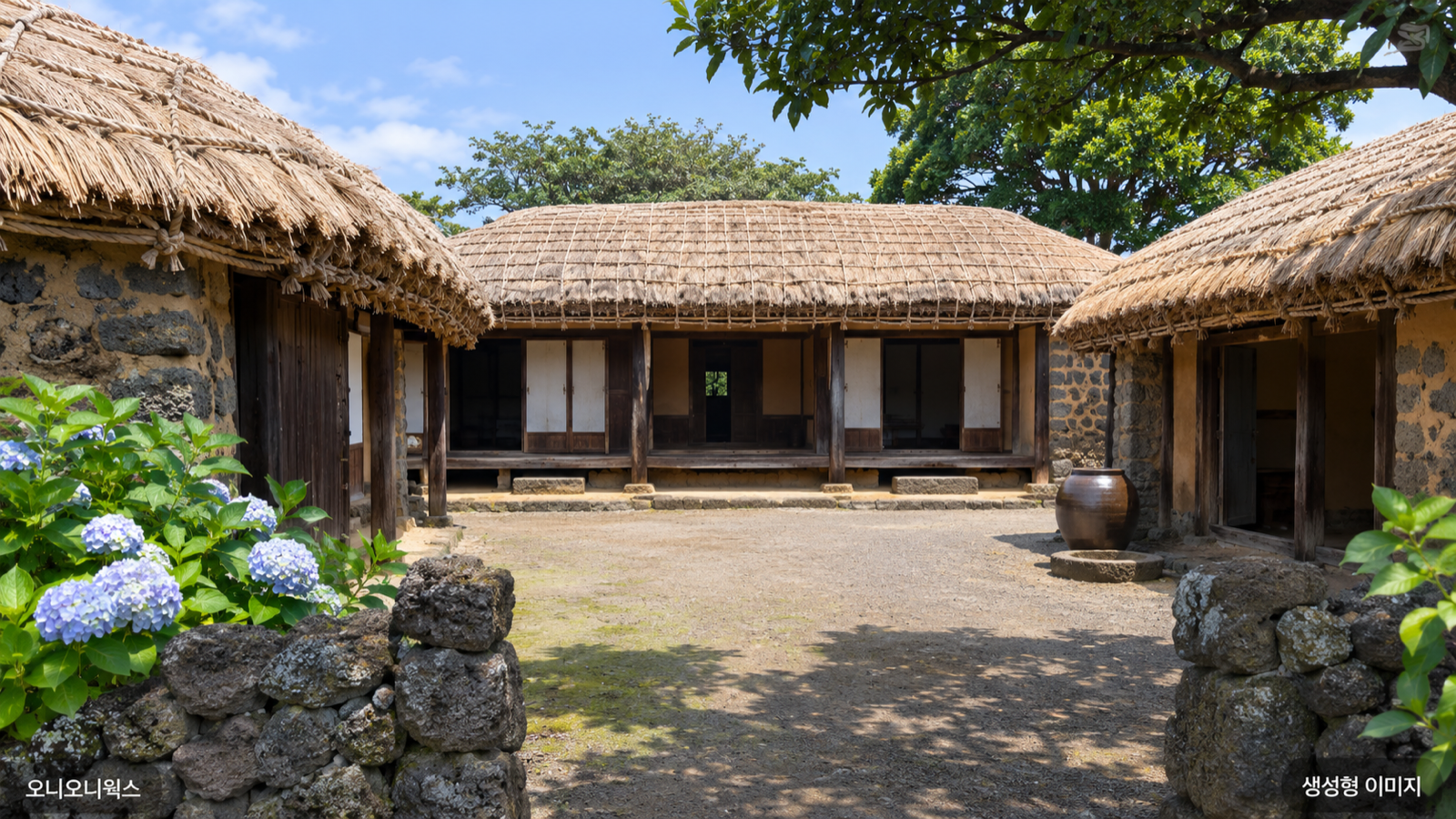
The Historic House of Go Chang-hwan is thought to have been built in the early 19th century.
It was once an inn where guests stayed.
A dot-tongsi (돗통시, a combined pigsty and toilet) remains at this house.
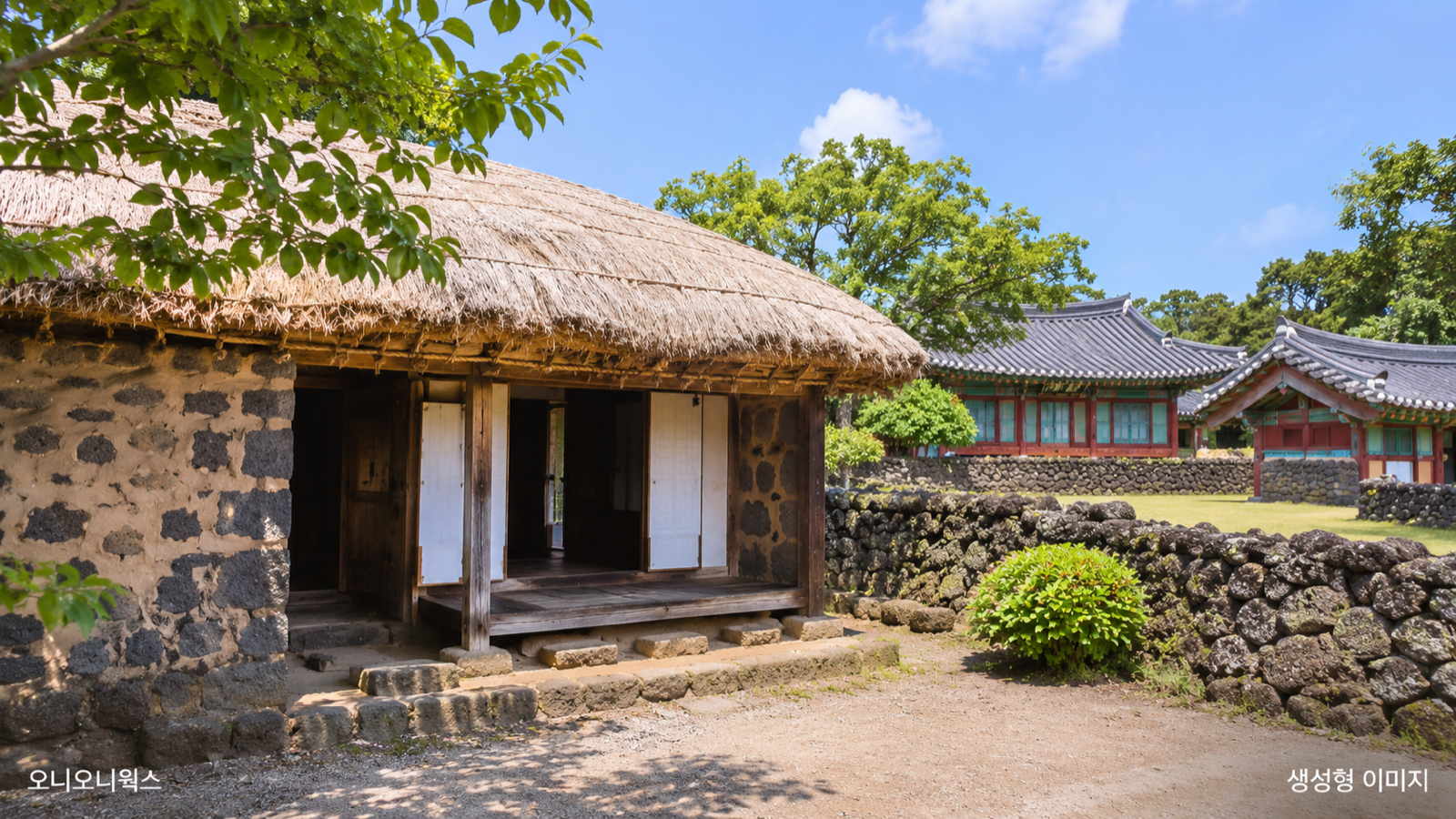
Jeonguihyanggyo Confucian School is right next door.
The school has Daeseongjeon (대성전) and Myeongnyundang (명륜당) halls. It was moved to its present location in 1849.
Oni’s tip
You can listen to commentary on Seongeup Folk Village and the historic houses of Go Pyeong-o and Go Chang-hwan on Odii (오디), the Korea Tourism Organization’s free audio guide app. Download the app to your phone beforehand and listen as you walk.
Read next — Gyeongbokgung Palace in Seoul: Hours, Admission, Free Entry in Hanbok, and Changing of the Guard
How to get to Seongeup Folk Village: Bus 121 from the airport or 221 from Jeju City
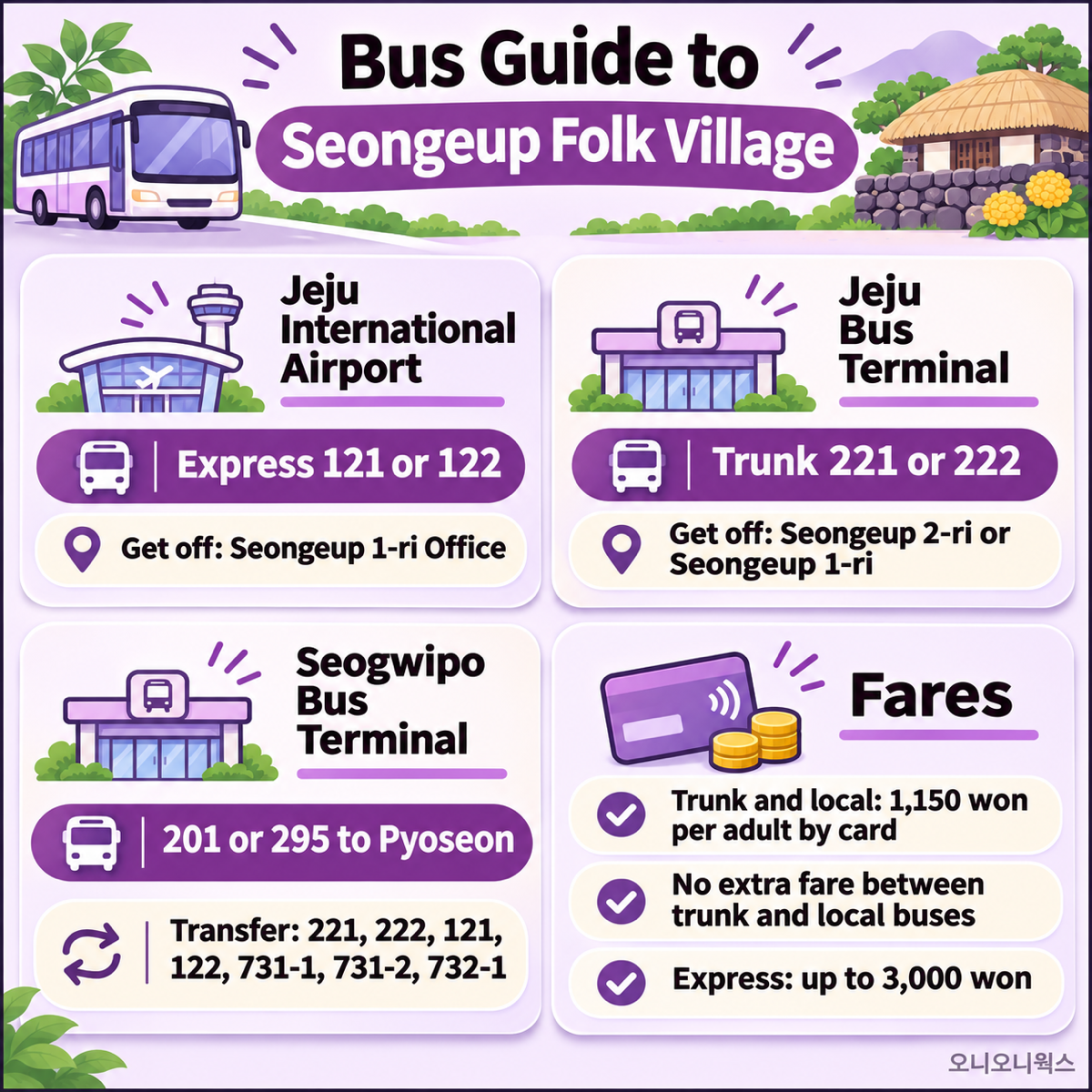
From Jeju Airport, take express bus 121 or 122 and get off at Seongeup 1-ri Office (성읍1리사무소).
From Jeju Bus Terminal, take trunk bus 221 or 222 and get off at Seongeup 2-ri (성읍2리) or Seongeup 1-ri (성읍1리).
There’s no direct bus to Seongeup from Seogwipo. Transfer once in Pyoseon.
In a map app such as Naver Map (네이버 지도), KakaoMap (카카오맵), or Google Maps (구글 지도), enter the Korean name 「성읍민속마을」.
The address is 「제주특별자치도 서귀포시 표선면 서성일로 20」.
| Starting point | Bus | Stop | Frequency |
|---|---|---|---|
| Jeju International Airport | Express 121 or 122 | Seongeup 1-ri Office | 121: every 55–140 minutes · 122: 3 times a day |
| Jeju Bus Terminal | Trunk 221 or 222 | Seongeup 2-ri or Seongeup 1-ri | 221: every 20–80 minutes · 222: 10 times a day |
| Seogwipo Bus Terminal (서귀포버스터미널) | 201 or 295 → transfer in Pyoseon | Seongeup 1-ri and other stops | 201: every 15–22 minutes · 295: every 1–3 hours |
Buses 121 and 122 from Jeju Airport
Bus 121 leaves the airport and stops at Seongeup 1-ri Office after passing Jeju Bus Terminal and Daecheondong (대천동).
The first 121 departs Donggwangyang (동광양) at 5:05 a.m., and the last departs at 9:35 p.m.
Bus 122 runs 3 times a day. The first bus is at 9:10 a.m. The last is at 8:15 p.m.
Express bus fares vary by distance. The maximum is 3,000 won.
Buses 221 and 222 from Jeju City
Buses 221 and 222 run from Jeju Bus Terminal along Beonyeong-ro (번영로), through Seongeup, and on to Pyoseon (Jeju Folk Village) (표선(제주민속촌)).
Bus 221 passes Bonggae-dong (봉개동), and bus 222 passes Jeju City Hall (제주시청).
The first 221 departs Donggwangyang at 5:10 a.m. The last departs at 9:25 p.m.
Bus 222 runs 10 times a day. The first bus is at 6:30 a.m. The last is at 8:40 p.m.
The adult fare is 1,150 won when paying by card.
I’d take bus 221 from Jeju City.
It runs more often each day than the other buses passing through Seongeup.
Buses 201 and 295 from Seogwipo to Pyoseon, then transfer
From Seogwipo Bus Terminal, first go to Pyoseon.
Bus 201 comes every 15–22 minutes. It stops at Pyoseon-ri Office (표선리사무소).
Bus 295 comes every 1–3 hours. It stops at Pyoseon-myeon Office (표선면사무소).
In Pyoseon, transfer to a bus bound for Seongeup.
Buses 221, 222, 121, and 122 pass Pyoseon-myeon Office and Pyoseon High School (표선고) on their way to Seongeup.
Buses 731-1, 731-2, and 732-1 run between Pyoseon (Jeju Folk Village) and Seongeup Culture Village (성읍문화마을).
There’s no additional fare when transferring between trunk and local buses.
By car, it takes about 40 minutes from Jeju Airport along Beonyeong-ro, or about 40 minutes from Seogwipo Central Rotary (서귀포 중앙로터리) along Ilju Road (일주도로).
Oni’s tip
Buses to Seongeup can be far apart. For the return trip, the last 221 leaves Pyoseon (Jeju Folk Village) at 10:35 p.m. The last 222 leaves at 9:35 p.m. Both pass through Seongeup on their way to Jeju Bus Terminal. When you get off in the village, check your return bus times in a map app first.
 WelcomeLet's explore Korea together
Seongeup Folk Village admission and visiting hours
There’s no admission fee for Seongeup Folk Village.
There are no set visiting hours or closing days.
It gets dark after sunset, making the village difficult to explore. Arrive before sunset.
People live here, so please avoid visiting too late.
Cultural tourism guides, who show visitors around and explain the village, offer free tours daily from 10 a.m. to 5 p.m.
You can apply in person at the guide office. You can also call 064-710-6810 to reserve a tour.
Guides employed by Jeju Special Self-Governing Province don’t introduce products or encourage you to buy them.
| Item | Details |
|---|---|
| Admission | Free |
| Visiting hours | No set hours · visit before sunset |
| Closing days | None |
| Guided tours | Daily, 10 a.m.–5 p.m. · free |
| Tour requests | In person · 064-710-6810 |
| Historic House of Go Pyeong-o | 10 a.m.–5 p.m. |
| Parking | Available |
| Pets | Allowed |
| Inquiries | 064-710-6797 |
The main entrance has no step, so wheelchair users can enter.
Two wheelchairs are available to borrow. There are also accessible restrooms and parking spaces.
The village has guesthouses and restaurants too.
Activities include Jeju folk songs, omegi-sul (오메기술, a traditional Jeju liquor), gosori-sul (고소리술, a traditional Jeju liquor), and natural dyeing.
Ask about activity schedules and prices at 064-710-6797.
In 2026, Jeju Province is considering an admission fee for the village.
Nothing has been decided yet. It’s still examining whether a fee is needed and gathering residents’ opinions.
I’d plan to arrive before 3 p.m.
Guided tours end at 5 p.m. You’ll also need to catch your return bus before sunset.
How visitors enjoy the village
Visitors say there’s a large free parking lot near the South Gate, the southern gate of Jeonguihyeonseong Fortress.
They say restrooms are near the parking lot. Some also say you can see a tourist route sign after getting off the bus.
Some visitors have walked around with a guide. They say it took about 40 minutes.
You can enter houses marked 「구경하는 집」, meaning houses open for viewing.
At these houses, residents may show you the tongsi and explain it.
Some reviews say visitors were encouraged to buy products such as omija syrup afterward.
Province-employed guides don’t sell products. If someone encourages you to buy something, you don’t have to.
The scenery around the village changes with the seasons.
Visitors say cosmos flowers bloom in front of the South Gate fortress walls in October and November.
Some reviews mention canola flowers in spring. Others mention buckwheat fields in late September.
Blooming times vary a little each year.
Oni’s tip
A visitor who came by bus said buses in eastern Jeju didn’t come often. They also said taxis were hard to find after 6 p.m. If you plan to return late, check the last bus times in advance.
Some visitors have also stopped at the tea house Oneureun Nokcha Hanjan (오늘은녹차한잔), about a 20-minute walk from the village.
I’d recommend Seongeup Folk Village if you want to see Jeju’s old thatched houses, stone walls, and a Joseon-era government building in one place.
There’s no admission fee, and you can walk around in 1 hour. That makes it a good half-day stop when visiting Pyoseon or eastern Jeju.
Prices, opening hours, and bus timetables can change. Before you go, check the Jeju Seongeup Village website and the Jeju Bus Information System.
If you’d like a guided tour, call 064-710-6810 before you leave to make a reservation.
― ― ―
This article brings together information published by the Korea Tourism Organization and Jeju Special Self-Governing Province, along with visitor reviews, as of November 19, 2026.
References: Korea Tourism Organization tourism information, “Seongeup Folk Village” · VisitKorea, “Life Preserved in Stone Walls and Thatched Houses: A Trip to Jeju Seongeup Village” · VisitKorea, “Seongeup Folk Village” · Jeju Special Self-Governing Province World Heritage Office, Jeju Seongeup Village website (visitor information, directions, designated cultural heritage, and “2026 Cultural Tourism Guide Information”) · Jeju Bus Information System routes and timetables for buses 121, 221, 222, 201, and 295 · Media Jeju, “Will Seongeup Folk Village, Where Visitors Could Freely Explore Old Jeju, Charge Admission?” · Halla Ilbo, “Admission Fee Under Consideration for Jeju Seongeup Village” · 6 Naver Blog visitor reviews
Photo credits: GPT 생성형 이미지 · FAM타임스 [https://img.famtimes.co.kr/famtimes/2026/11/659661fb-1f14-4d2f-8e5c-add545b40d60.webp] · 비짓제주 [https://api.cdn.visitjeju.net/photomng/imgpath/201804/30/7be1a657-d21c-43dc-9fae-e33797dd8f8c.webp] · 뉴시스 [https://img1.newsis.com/2018/12/10/NISI20181210_0000241948_web.jpg?rnd=20181210104237]